Premium Makhana from Bihar - festival offer - up to 25% OFF!
Amazing Benefits of Makhana You Should Know

Introduction
Some snacks feel healthy only because the packet says so. Fox nuts are different. Plain roasted makhana has a real nutritional story behind it: very low intrinsic fat, moderate protein, useful minerals, and a low glycemic index in one small human study. That does not make it a miracle food, but it does make it one of the more intelligent pantry swaps you can make when you want crunch without diving straight into deep-fried snacks.
What also makes makhana interesting is that it is not just a trend snack borrowed from wellness culture. It comes from Euryale ferox, an aquatic crop with deep roots in South Asia, and India remains the global leader in production. Official trade reporting from [APEDA’s makhana report](https://apeda.gov.in/sites/default/files/study_reports/Makhana_Report_English.pdf?utm_source=chatgpt.com) notes India’s dominant role in the category, while a [Press Information Bureau release](https://www.pib.gov.in/PressReleasePage.aspx?PRID=2165963&utm_source=chatgpt.com) says GI-tagged Mithila Makhana reached export markets including the UAE and USA in 2024–25.
That combination of tradition, practicality, and evidence is exactly why makhana deserves a closer look. If you want to understand the nutrition science behind fox nuts, the clearest place to start is the [Springer study on roasted fox nuts](https://link.springer.com/article/10.1186/s43014-021-00081-x?utm_source=chatgpt.com), then pair it with the official micronutrient background from the [NIH magnesium fact sheet](https://ods.od.nih.gov/factsheets/Magnesium-HealthProfessional/?utm_source=chatgpt.com) and [NIH phosphorus fact sheet](https://ods.od.nih.gov/factsheets/Phosphorus-HealthProfessional/?utm_source=chatgpt.com). Those sources paint a much more useful picture than generic “superfood” marketing.
A smarter way to think about fox nuts
The most useful comparison is not “makhana versus every snack on earth.” It is plain or lightly seasoned fox nuts versus the heavily flavored versions people actually buy. That is where the real health difference shows up.
| Type of fox nuts snack | What stays appealing | What you need to watch |
|---|---|---|
| Plain roasted | Closest to the low-fat, low-GI base food studied in research | Can feel bland if under-seasoned |
| Light masala roasted | Better flavor and crunch, which can make healthier snacking easier to stick with | Sodium can rise quickly |
| Sweet-coated | Still portable and crunchy | Added sugar can erode the “smart snack” advantage |
| Ghee-heavy homemade | Excellent aroma and richness | Extra fat increases calorie density fast |
This table is a practical interpretation of the fox nut roasting study, combined with official sodium and saturated-fat guidance. The base food remains compelling, but the more salt, sugar, and fat you pile onto it, the more you drift away from what makes makhana useful in the first place. The [WHO sodium guidance](https://www.who.int/news-room/fact-sheets/detail/sodium-reduction?utm_source=chatgpt.com) recommends adults stay under 2,000 mg of sodium a day, and both the [Dietary Guidelines saturated fat factsheet](https://www.dietaryguidelines.gov/sites/default/files/2021-11/DGA_FactSheet_SaturatedFats-07-09_508c_0.pdf?utm_source=chatgpt.com) and the [FDA Nutrition Facts label guide](https://www.fda.gov/food/nutrition-facts-label/how-understand-and-use-nutrition-facts-label?utm_source=chatgpt.com) emphasize limiting saturated fat and sodium when you choose packaged foods.
That is the fresh perspective most makhana articles skip: fox nuts are not automatically healthy because they are fox nuts. They are healthiest when you preserve the strengths of the base ingredient.
The benefits that matter most
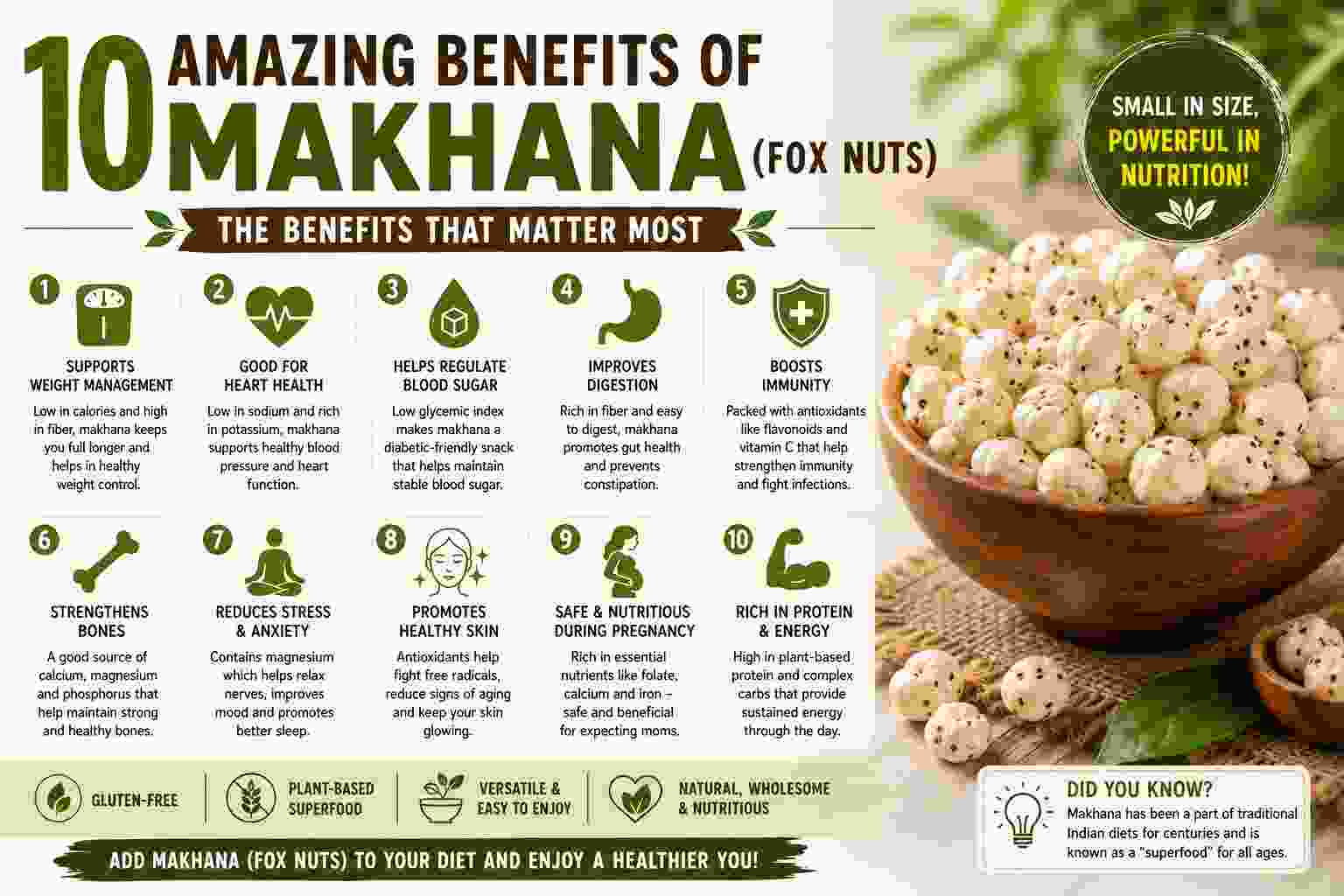
Here are the benefits that genuinely stand out, with the strongest evidence and the most practical value placed first.
It gives you crunch without the fat load of many snack foods.
One of makhana’s biggest advantages is simple: the base food is naturally very low in fat. In the roasted fox nut study, fat content remained below 1% on a dry basis, and the authors noted that fox nuts contain much less fat than many conventional nuts. APEDA’s market report similarly highlights makhana’s very low fat profile compared with almonds and cashews. That makes fox nuts especially useful for people who want a savory snack that feels indulgent without being oil-heavy.
It may support a steadier blood sugar response.
This is one of the most interesting findings in the research. In a human trial with healthy adults, roasted fox nuts showed a glycemic index of about 37, which falls into the low-GI range. Broader evidence on low-GI eating patterns suggests that reducing dietary glycemic response can improve markers relevant to metabolic health, though results vary by population and overall diet. The important takeaway is not that makhana “treats” diabetes, but that plain roasted fox nuts appear to be a gentler carbohydrate snack than many refined, fast-digesting alternatives.
It offers more nutritional substance than its airy texture suggests.
Fox nuts look feather-light, so people often assume they are nutritionally empty. They are not. In the roasting study, protein rose from 11.40% to 14.57% after roasting, and the authors also highlighted fox nuts as a good vegetarian protein source with an essential amino acid profile that compares favorably with many plant foods. This does not make makhana a primary protein food like beans, dairy, tofu, or eggs, but it does make it a more meaningful snack than the usual “empty crunch.”
It contributes minerals that matter every day.
Roasted fox nuts were found to contain potassium, magnesium, phosphorus, calcium, iron, sodium, and zinc in the Springer study. What matters more than memorizing the numbers is understanding the roles: the NIH notes that magnesium is involved in more than 300 enzyme systems, while phosphorus is essential for bones, teeth, DNA, RNA, and energy metabolism. In other words, makhana is not just a crunchy carb; it also contributes minerals that support fundamental body functions.
Roasting improves more than texture.
A lot of snack foods become less interesting nutritionally after processing. Fox nuts are unusual because roasting improved several markers in the study. Researchers found higher protein, higher mineral content, higher phenolics, higher flavonoids, stronger antioxidant activity, and much better crunch after roasting. The practical lesson is easy: if you are buying or making makhana, lightly roasted versions are not just tastier; they may also be the more functional choice.
It can support weight-management goals when used as a swap, not a free pass.
This is where honesty matters. Makhana is often marketed as a weight-loss snack, but the better claim is narrower and more accurate: fox nuts can help if they replace higher-fat, more energy-dense snacks. The roasting study found that roasted fox nuts still deliver meaningful calories, and calorie density actually rose after roasting. At the same time, the combination of very low fat and low GI may make them more satisfying than many fried snacks. Low-GI dietary patterns have shown modest benefits for body weight in some reviews, but portion size still matters.
It makes smarter snacking easier to sustain.
Nutrition advice fails when food is boring. The sensory side of fox nuts matters because people are more likely to stick with a better snack if it tastes good. In the roasting study, spice-roasted versions scored highest for aroma, texture, flavor, and crunchiness. That is a deceptively important benefit: a food that is both reasonably nutritious and genuinely enjoyable has a better chance of becoming a long-term habit.

It gives you more control over sodium, sugar, and saturated fat than most packaged snacks.
One of the best things about fox nuts is how easy they are to prepare at home. You can season them with black pepper, cumin, chaat masala, curry leaves, smoked paprika, or a little chili and still keep the base food intact. That matters because official guidance from WHO and the FDA consistently points readers to limit sodium and saturated fat, and homemade or lightly seasoned fox nuts make that much easier than relying on heavily processed savory snacks.
It has promising antioxidant and pharmacological potential, but the evidence gap is important.
This is the part where makhana articles often go overboard. Reviews of Euryale ferox describe polyphenols and other compounds linked with antioxidant, hypoglycemic, cardioprotective, hepatoprotective, and other bioactive effects. That is exciting, but much of that literature is phytochemical, experimental, or preclinical. The strongest direct human evidence I found is still the glycemic-response and roasting work, not large clinical trials proving disease treatment. So yes, fox nuts are promising, but they are best understood as a nutritious food, not a cure.
It upgrades snack quality without asking you to abandon familiar flavors.
This may be the most underrated benefit of all. A good snack does not just need nutrients; it needs cultural fit. Makhana works because it slips easily into flavors people already love, whether that is black salt and pepper, curry leaf and hing, peri-peri, or a light ghee roast. And because the crop is increasingly tied to traceability, GI recognition, and export quality, choosing fox nuts can feel less like following a fad and more like backing a traditional food that is finally getting its due.
How to get the most from fox nuts
If you want the benefits of fox nuts to be real and not just theoretical, the best strategy is simple. Start with plain or lightly salted makhana. Roast or re-toast it at home if needed, and let spices do most of the work before you lean on extra ghee, cheese powder, caramel, or heavy sweet coatings. That preserves the low-fat base that makes fox nuts interesting in the first place.
The next rule is label awareness. This is where many “healthy” snacks quietly become less healthy. The [FDA’s guide to the Nutrition Facts label](https://www.fda.gov/food/nutrition-facts-label/how-understand-and-use-nutrition-facts-label?utm_source=chatgpt.com) specifically flags sodium and saturated fat as nutrients many people should get less of, and the [WHO sodium guidance](https://www.who.int/news-room/fact-sheets/detail/sodium-reduction?utm_source=chatgpt.com) recommends keeping total sodium intake below 2,000 mg per day. So if you buy flavored fox nuts, check how much sodium, saturated fat, and added sugar come with each serving instead of assuming the packet is doing you a favor.
Finally, remember that portion still matters. In the fox nut study, roasted makhana reached roughly 382 kcal per 100 g, which means it is easy to overdo if you snack mindlessly from large family packs. A bowl works better than a bottomless pouch. Fox nuts are a smart swap, but they are still food, not a loophole.
Frequently asked questions
Are fox nuts healthy enough for everyday snacking?
Yes, they can be, especially in plain or lightly seasoned form. Their strongest advantages are low intrinsic fat, moderate protein, useful minerals, and a low GI in one human study. But the everyday version should be the simple one, not the heavily salted or sweet-coated version.
Are fox nuts good for people with blood sugar?
They can fit well into a blood-sugar-conscious eating pattern because roasted fox nuts showed a low GI of about 37 in a small human study. That said, the evidence is still limited, and preparation matters. A caramel-coated or sugar-heavy fox nut snack is not the same as plain roasted makhana.
Do fox nuts really help with weight loss?
They can help indirectly if they replace fried, energy-dense snacks, because the base food is very low in fat and sits within the logic of lower-GI snacking. But fox nuts still contain calories, and roasted makhana is easy to overeat if you treat it as “free food.” Think of them as a better swap, not a magic fix.
Is roasted makhana better than unroasted makhana?
Based on the study cited here, yes. Roasting improved crunch, consumer acceptance, protein, mineral concentration, phenolics, flavonoids, and antioxidant activity. That makes lightly roasted fox nuts the most compelling form for both taste and practicality.
What should I check before buying packaged fox nuts?
Keep the ingredient list short and pay attention to sodium, saturated fat, and added sugar. The base ingredient is strong, but seasonings can quickly change the snack’s overall profile. The FDA label guide is especially helpful here, and WHO’s sodium recommendation gives a useful reality check for salty packaged snacks.
Final takeaway
The smartest way to describe makhana is this: fox nuts are a strong base snack, not a miracle snack. Their value comes from a combination of very low fat, moderate protein, useful minerals, improved antioxidant markers after roasting, and a low glycemic index in a small human study. Add in the fact that they are easy to season at home and rooted in a traditional crop that now carries GI-tagged recognition and export momentum, and you get a food that is both practical and meaningful.
If you are updating your snack shelf, fox nuts are worth more than a casual trial. Try one plain roasted batch, season it lightly, and judge it the right way: not by wellness hype, but by whether it helps you snack with a little more intention and a lot less regret.