Premium Makhana from Bihar - festival offer - up to 25% OFF!

Fox Nuts vs Protein Bars: Which Snack Actually Wins?

Introduction
Fox nuts have become the “good snack” of modern pantries: light, crunchy, familiar, and easy to feel virtuous about. Protein bars, meanwhile, are the hyper-efficient overachievers of the snack world. They promise satiety, muscle support, and convenience in one wrapper. So when you’re standing in front of the cabinet at 4 p.m., what’s the better pick?
The answer depends on what job you’re hiring the snack to do. If you want something crunchy, lighter, and less engineered, fox nuts have a real case. If you want a snack that can meaningfully move your protein intake, most fox nuts are simply not in the same league as a true protein bar. For context, published composition data for popped Euryale ferox put fox nuts at about 358 kcal and 9.7% protein per 100 g, which works out to roughly 107 calories and about 3 g protein for a 30 g snack portion. By contrast, current bar labels range from about 12 g protein for some RXBAR and KIND Protein options to 20 g for some Quest bars.
The fair comparison
Most blog posts compare fox nuts to protein bars as if they are competing in the same weight class. They usually are not. A better comparison looks at four things: protein dose, calorie cost, ingredient complexity, and what kind of fullness the snack creates. That last point matters because protein does tend to increase satiety, which is one reason a well-formulated protein bar can keep you fuller than a crunchy but low-protein snack.
| Option | Representative serving | Calories | Protein | Protein per 100 kcal | Best fit |
|---|---|---|---|---|---|
| Plain fox nuts | ~30 g | ~107 | ~2.9 g | ~2.7 g | Light everyday snacking |
| Quest bar example | 1 bar | 180 | 20 g | ~11.1 g | Post-workout or missed-meal backup |
| RXBAR example | 1 bar | 180 | 12 g | ~6.7 g | Simpler ingredient list, moderate protein |
| KIND Protein example | 1 bar | 250 | 12 g | ~4.8 g | Nut-forward, richer snack |
Using current labels from Quest Nutrition, RXBAR, and KIND Snacks, the protein-efficiency gap is pretty obvious: fox nuts are the lightest option, but not the strongest protein-delivery system. In plain English, if your snack’s main purpose is “give me protein,” a bowl of fox nuts loses quickly. If the purpose is “give me something crunchy that doesn’t feel heavy,” fox nuts become much more competitive.
That is the first big insight: this is not a clean-eating morality tale. It is a job-description problem.
Where fox nuts win
Fox nuts win on ingredient simplicity and snackability. A plain roasted makhana bowl feels like food. It does not feel like supplementation. That matters more than nutrition-nerd culture usually admits, because not every snack is solving a muscle-recovery problem. Sometimes you just want to chew something salty and crunchy without turning snack time into a chemistry project.
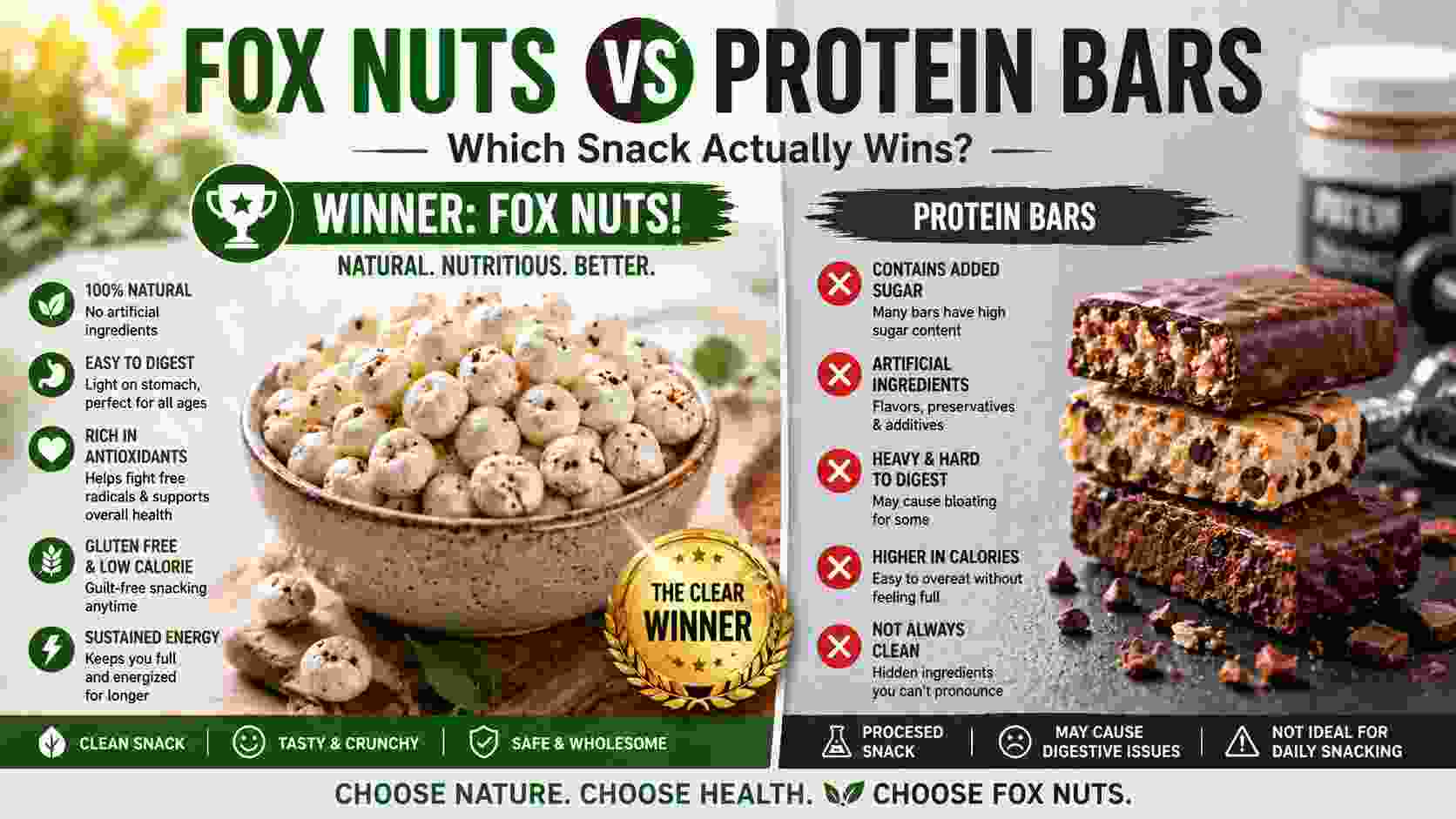
They also tend to win on lightness. A modest serving of fox nuts gives you a visually generous portion for relatively few calories, and because they are usually very low in fat, they do not hit with the density of a nut-heavy bar. That makes them useful for desk snacking, evening snacking, or those moments when you want “more bites” rather than “more macros.” The protein is modest, but the snack experience is strong.
There is also real food-science value here. A 2022 study on roasted fox nuts found improvements in measured protein, phenolics, flavonoids, and antioxidant activity after roasting. That is not a free pass to call fox nuts a high-protein food, but it does support the idea that properly processed fox nuts can be more than an empty crunchy filler.
Fox nuts also avoid one drawback that some bars bring along: stomach drama. Some highly formulated bars use sugar alcohols or dense fiber systems to keep sugars low while pushing protein up. That can work well for some people, but not for everyone. The fox-nut advantage is that plain versions are usually easier to understand and easier to portion.
Where protein bars win
Protein bars win on the thing their name claims: protein. The International Society of Sports Nutrition position stand notes that an acute dose of roughly 20–40 g of high-quality protein is a useful target in exercise contexts. If you use the published 9.7% protein figure for popped fox nuts, you would need a little over 200 g of fox nuts just to reach the lower 20 g end of that range. That is far beyond a normal snack portion. A single Quest bar gets there immediately, and even a 12 g bar puts you materially closer than fox nuts do.
Bars also win when your day is chaotic. A wrapped, pre-portioned bar is built for handbags, gym bags, airport delays, and the “I accidentally worked through lunch” problem. On those days, the better snack is often the one you will actually have with you.
But protein bars are not one thing. This is the second big insight, and it changes the entire debate. A Quest-style bar is a formulation-first bar: protein isolates, prebiotic fiber, erythritol, and non-nutritive sweeteners are all part of the build. An RXBAR is far closer to a compact whole-food bar made from dates, egg whites, and nuts. A KIND Protein bar sits somewhere in between, with peanuts as the lead ingredient but also soy protein isolate, glucose syrup, honey, and sugar.
That ingredient spread matters because more processing deserves more label scrutiny. Harvard T.H. Chan School of Public Health notes that the ingredients list and nutrition label are useful tools for deciding when to include more processed foods, especially low-nutrient ultra-processed products high in added sugars, sodium, and unhealthful fats. Not every protein bar belongs in that bucket, but some clearly sit closer to it than others.
There is also a hidden comfort issue. The FDA’s sugar-alcohol guidance notes that these sweeteners can cause gas, bloating, and diarrhea in some people. That does not mean protein bars are “bad.” It means a bar that looks perfect on paper may be a poor everyday choice if it makes your stomach miserable.
The smarter verdict
Here is the freshest way to think about the matchup: not every snack needs to solve hunger the same way. Harvard T.H. Chan School of Public Health notes that people snack for many reasons beyond hunger, including boredom, food culture, indulgence, and the surrounding food environment. If your afternoon habit is mostly about wanting crunch, salt, and interruption, fox nuts often solve the real problem better than a dense bar.
If your real problem is protein, fox nuts need help. And this is where a practical middle path appears. Instead of asking fox nuts to become a protein bar, pair them with an actual protein food: Greek yogurt, paneer, skyr, cottage cheese, roasted chana, or even a glass of milk. That gives you the texture and familiarity of fox nuts without pretending they are a stand-alone recovery snack.
My rule of thumb is simple. Use fox nuts as an everyday snack base. Use protein bars as a tool. A tool can be excellent without needing to become your default food.
Conclusion and call to action
So, which one wins?
If the question is “What’s the better everyday snack to keep on regular rotation?”, fox nuts win. They are lighter, simpler, easier to eat mindfully, and better at satisfying the very normal human desire for a savory crunch without forcing every snack into “performance nutrition” mode. If the question is “Which snack does a better job of delivering meaningful protein?”, protein bars win decisively. The protein gap is simply too large to ignore.
The most useful takeaway is not “fox nuts good, protein bars bad” or the reverse. It is this: pick the snack that matches the purpose. For crunch, simplicity, and daily snacking, reach for fox nuts. For travel, recovery, or a genuine protein top-up, reach for a carefully chosen bar. And when you shop, use the label the way the U.S. Food and Drug Administration recommends: use %DV to spot what is low or high, remember that 5% DV is low and 20% DV is high, favor fiber, and keep a closer eye on saturated fat, sodium, and added sugars; the Daily Value for protein is 50 g.
If you’re publishing this piece, invite readers to vote with their pantry. Ask them: Are you Team Fox Nuts or Team Protein Bar—and what does your snack need to do for you? That question will get better comments than a generic “Which is healthier?” ever will.
[…] makes makhana even more interesting is that it is not a new wellness fad pretending to be ancient. Fox nuts are the popped seeds of Euryale ferox, an aquatic crop with a long food history in South Asia and […]