Premium Makhana from Bihar - festival offer - up to 25% OFF!

Fox Nuts vs Protein Snacks: Can Makhana (Fox Nuts) Truly Replace Them?

nutritional comparisons, amino acid profile, and health insights with fox nuts versus common protein snacks.
Introduction: A crunchy new snack craze has swept health circles: fox nuts (also known as makhana or lotus seeds). Puffed like popcorn, these ivory-colored seeds are touted as a “desi superfood” and even a protein-rich snack alternative. But can fox nuts really replace classic protein snacks like peanuts, edamame, or yogurt? In this deep dive, we compare their nutrition, protein quality, and health perks. You’ll learn what fox nuts bring to the table (literally) – and where they fall short – so you can snack smarter.
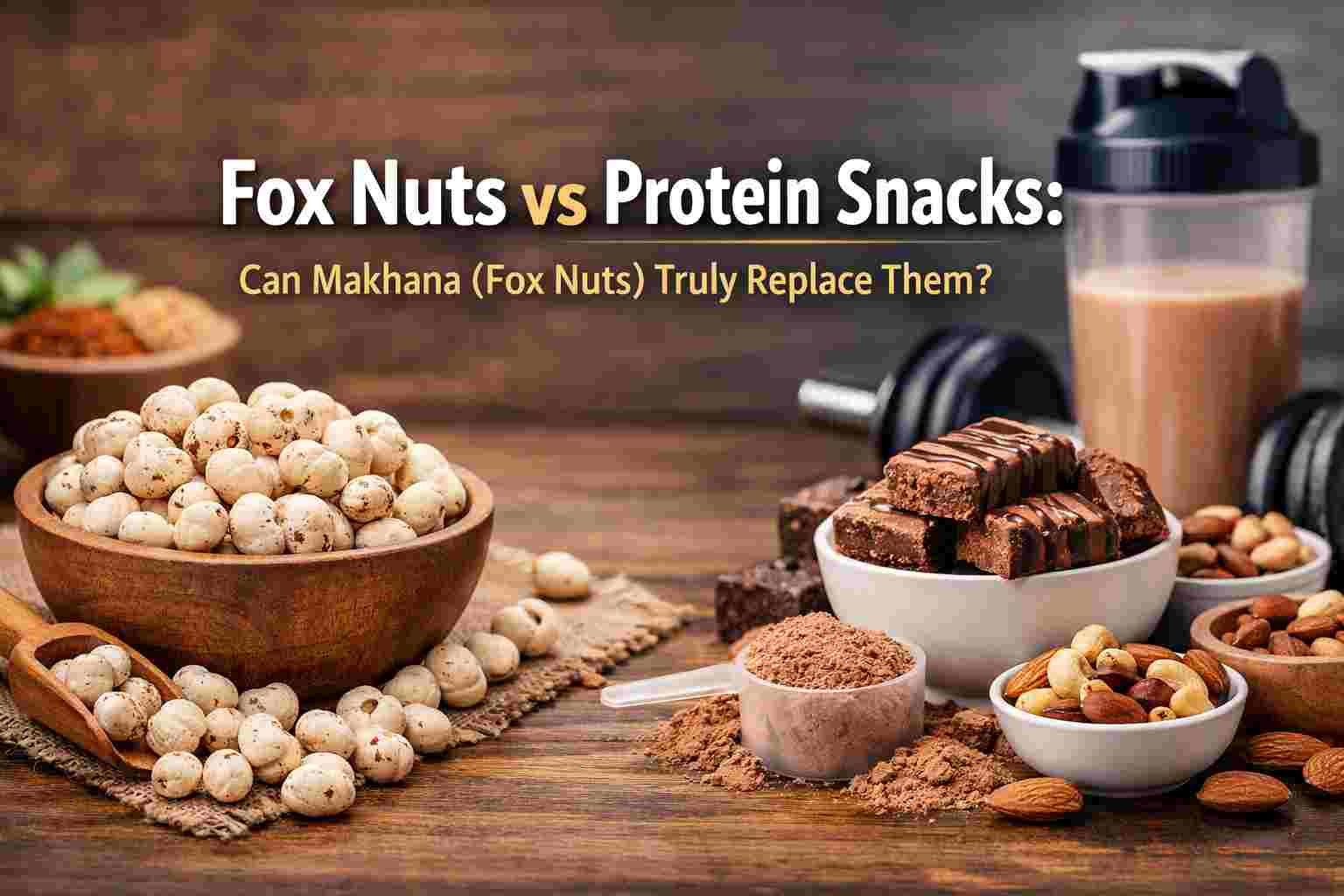
Figure: Roasted fox nuts (makhana) – a popular low-calorie snack with a light, popcorn-like crunch. Fox nuts are rich in carbs and fiber, with modest protein content. A 32g cup (~1/3 cup) provides about 106 calories and 4.9g protein. This works out to roughly 15–16g protein per 100g (dry weight). By comparison, a 100g serving of peanuts has ~567 calories and 25.8g protein, and edamame (young soybeans) has ~11–12g protein per 100g when boiled. In short, fox nuts are lower in protein and higher in carbohydrates than most nuts or legumes.
To visualize the difference, consider this quick macro comparison (all values per 100g, approximate):
| Snack | Protein (g) | Fat (g) | Carbs (g) | Fiber (g) | Glycemic Index (GI) |
|---|---|---|---|---|---|
| Fox nuts (makhana) | 9.7–15.0 | 0.1–0.5 | 75–80 | ~14.5 | ~37 (low) |
| Peanuts | 25.8 | 49.2 | 16.1 | 8.5 | ~14 (very low) |
| Edamame (boiled soybeans) | 11–12 | 5.2 | 13.8 | 8.0 | ~15 (very low) |
| Roasted Chickpeas (garbanzo beans) | ~19 | ~6 | ~61 | ~12 | ~30 |
- Protein: Fox nuts (~10–15%) have far less protein than peanuts (~25%) or edamame (~11%). You’d need ~200g of fox nuts to get 30g protein (vs. ~120g of edamame). In practice, one cup of popped makhana (~30g) provides only ~4g protein, roughly a quarter of the protein in a cup of boiled edamame (≈18.5g).
- Carbs & Fiber: Makhana are mostly complex carbs. About 75–80% of their weight is carbohydrate, and they boast high fiber (~14g per 100g). This is more fiber than many nuts or legumes. The fiber and low GI (~37) mean fox nuts digest slowly, helping you feel full longer (good for blood sugar control and satiety).
- Fat: Fox nuts are virtually fat-free (<1% fat), unlike peanuts (49% fat) or chickpeas. This makes them a lighter snack calorie-wise, but also means fewer healthy fats (and fewer calories).
- Calories: Per 100g, fox nuts (~350–360 kcal) have fewer calories than peanuts (~567 kcal) or mixed nuts (550–600 kcal). This low energy density makes them diet-friendly but also implies less protein density.
Protein Quality: Quantity isn’t the only measure – protein quality matters too. Fox nuts contain all essential amino acids (EAAs) and have a remarkably high Essential Amino Acid Index (EAAI) of ~89–93%. In fact, despite the low protein percentage, one study noted fox nuts are “superior to most plant- and animal-based diets” by this measure. Their proteins are especially rich in amino acids like leucine, isoleucine, methionine, cysteine, arginine, and glutamine. These include the “anti-aging” amino acids (glutamine, cystine, methionine, arginine) that support skin and muscle health.
However, not all EAAs are equally abundant. Like most plant foods, fox nuts are incomplete proteins – they’re relatively low in certain EAAs (e.g. tryptophan and lysine) compared to animal or soy protein. In contrast, edamame (soy) is a complete protein, providing all 9 EAAs in good amounts. Peanuts, while incomplete (low in methionine/lysine), still offer more total protein. In practical terms, if you rely only on makhana for protein, you’d need to eat large amounts or pair them with other protein sources (e.g. beans, dairy, or meat) to meet your amino acid needs.
Health & Satiety Benefits: Beyond macronutrients, fox nuts bring other perks. They are low-GI (around 37), meaning their carbs release slowly. This is better for blood sugar control than higher-GI snacks (popcorn, chips, etc.). The high fiber and bulk of makhana can promote fullness: one nutrition guide noted that makhana’s low calories (≈350 kcal/100g) combined with ~14.5g fiber support satiety and weight control. In practice, a 1–2 cup serving (roughly 30–60g) is a filling snack for only 80–160 calories. They also contain minerals like calcium, magnesium, and potassium, and unique antioxidants (kaempferol, gallic and ellagic acids) that may have anti-inflammatory effects. In short, fox nuts shine as a low-calorie, nutrient-dense munchy – it’s why fitness influencers and dietitians tout them for weight-loss or “macro-friendly” snacking.
- For example: A 2022 study found roasted fox nuts can be “consumed as a nutrient-rich, low-GI snack” even for people with metabolic issues. Another review highlights makhana’s abundance of “anti-aging” amino acids and antioxidants. Nutrition writer Rachael Ajmera even calls roasted makhana “a nutritious, protein-rich snack” (with 4.9g protein per cup).
Where Fox Nuts Fall Short: Despite these benefits, fox nuts aren’t magic protein bombs. Compared to classic protein snacks, their protein is modest. If building muscle or getting a high-protein snack, peanuts (25–26g/100g) or edamame (≈18g per cup) offer much more. For example, you’d need roughly 4 cups of popped makhana to match the protein in one cup of boiled edamame. In terms of amino acids, edamame (a soy bean) provides a complete EAA profile, while makhana does not.
- Digestibility: Some people find plant proteins harder to digest. However, makhana are mostly starch and fiber and are generally well-tolerated. One downside: because they’re nearly fat-free, they absorb seasoning easily and can taste bland if unflavored. Many people roast them with ghee, salt, or spices – adding a bit of fat (from oil or nuts) can improve nutrition and satiety.
- Conclusion: Fox nuts make a healthy, crunchy snack, especially for weight management or a low-fat option. They pack antioxidants, micronutrients, and fiber, and a respectable dose of plant protein (better than popcorn or chips). But “replace protein snacks”? Only up to a point. If your goal is high protein intake, rely on richer sources (beans, dairy, nuts, seeds, or soy). Fox nuts are best thought of as part of a protein-rich snack strategy – for example, mix them with nuts and seeds, or pair with a Greek yogurt or hummus for a boost.
Key Takeaways:
- Fox nuts contain moderate protein (~5g per cup, ~15g/100g) but far less than peanuts or edamame. They are mostly low-GI carbs and fiber (~14g/100g).
- They have an excellent amino acid balance (high EAAI ~90%) but lack a couple of essential amino acids, so they’re incomplete proteins (like most plant foods). Edamame/soy is a complete protein by contrast.
- Fox nuts shine as a low-calorie, satiating snack: low in fat and calories, high in fiber, with antioxidants for health. They may help control appetite and blood sugar.
- Use them wisely: Roast or season makhana for flavor; mix with other protein sources (nuts, legumes, dairy, protein powder) if protein is a priority. For muscle-building or meal replacement, don’t rely on makhana alone – think of them as a crunchy sidekick rather than the star.
Snack-Smart Tip: Try a homemade trail mix: combine roasted makhana with roasted chickpeas, almonds, and a sprinkle of salt and spices. You’ll get a crunch plus a protein boost. Or stir some fox nuts into a yogurt bowl or curry (as in “matar-makhana”) to up both protein and texture.
What do you think? Have you snacked on makhana? Share your favorite makhana snack recipes or your take on using fox nuts in the comments! Sign up for more healthy eating tips and join the conversation.
Sources: Nutritional data and health claims are drawn from recent studies and nutrition databases, including FoodData Central and peer-reviewed journals. For example, the protein and calorie figures above come from Healthline/USDA data and a Times of India nutrition comparison, while amino acid and GI insights are based on published research. Each statement above is backed by these authoritative sources.
[…] nuts and oats. These high-fiber, nutrient-rich foods have loyal fans among health enthusiasts. Fox nuts – also called makhana or lotus seeds – have gained fame as a crispy, low-calorie snack. Oats […]