Premium Makhana from Bihar - festival offer - up to 25% OFF!

Why Fox Nuts Are Better Than Junk Snacks

Introduction
Most snack cravings are not really about hunger. They are about texture. You want crunch, salt, and something instantly satisfying. That is why packets of chips, puffs, and fried namkeen disappear so fast.
This is exactly where fox nuts stand out. Plain roasted makhana gives you the crunch people chase in junk food, but without the same fat-heavy, highly engineered snack profile. The World Health Organization recommends limiting salty snacks, and nutrition guidance from Harvard notes that frequent intake of ultra-processed, hyperpalatable snacks high in salt, sugar, and fat can worsen diet quality and reinforce preference for those foods.
What makes makhana even more interesting is that it is not a new wellness fad pretending to be ancient. Fox nuts are the popped seeds of Euryale ferox, an aquatic crop with a long food history in South Asia and China. In other words, this is not “healthy snacking” invented in a marketing meeting. It is a traditional food that happens to fit today’s need for smarter snacking remarkably well.
What fox nuts do differently
At a basic nutrition level, fox nuts look very different from typical junk snacks. Peer-reviewed and review sources describe makhana as high in carbohydrate, moderate in protein, and strikingly low in fat. Published compositions put raw makhana at about 76.9% carbohydrate, 9.7% protein, and 0.1% fat, while popped makhana is reported at about 84.9% carbohydrate, 9.5% protein, and 0.5% fat.
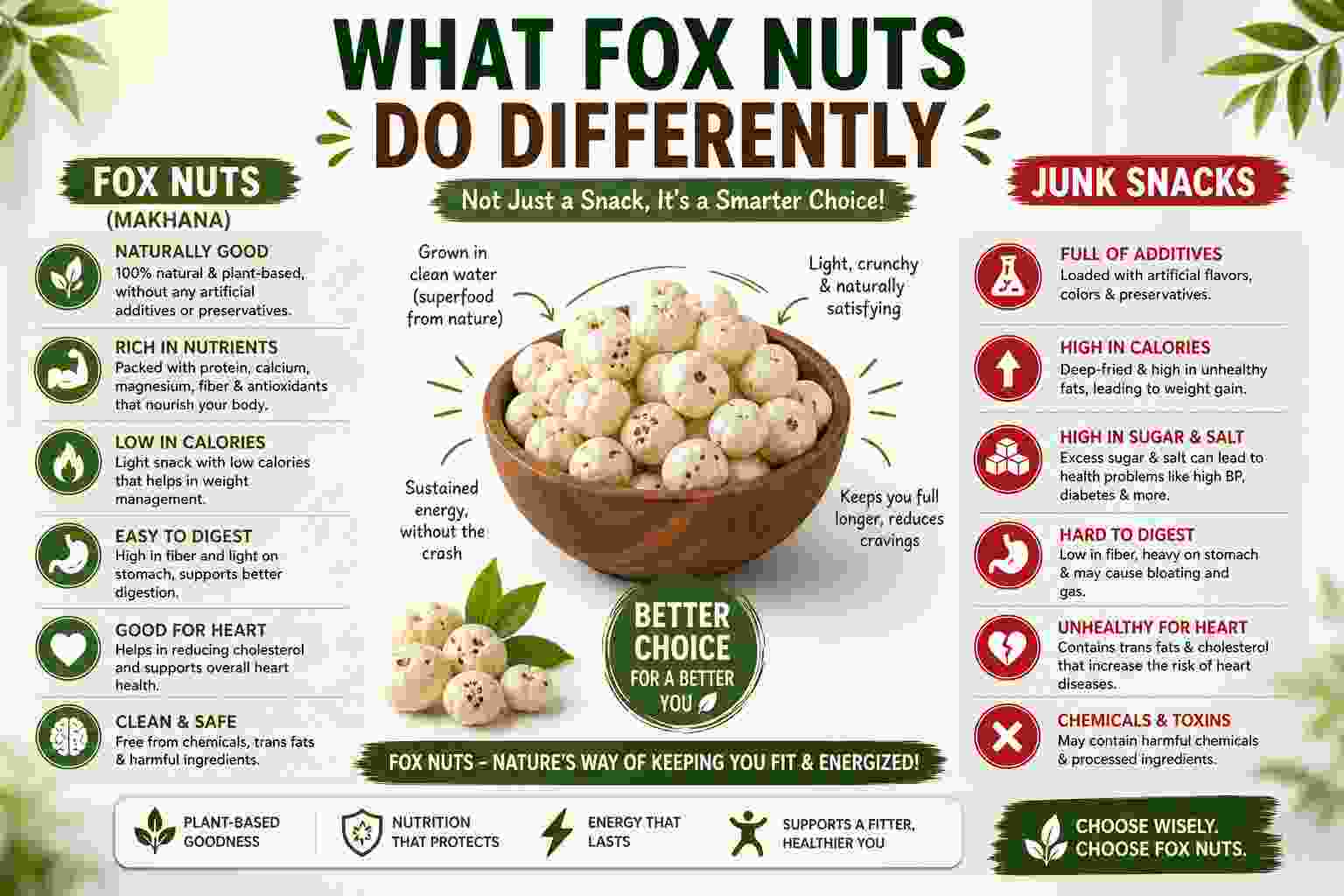
That matters because the biggest benefit of fox nuts is often misunderstood. Their advantage is not that they are some wildly high-protein snack. Social media sometimes oversells that part. A normal snack portion gives only around 3 grams of protein. The bigger win is that makhana deliver crunch with very little fat compared with chips and cheese puffs. So if you want the honest version, makhana beat junk snacks mainly on fat load, ingredient simplicity, and ease of portioning, not because they magically turn snack time into a protein shake.
There is also some promising science behind how makhana behave in the body. A 2022 study reported that roasted makhana had a low glycemic index of about 37 in human subjects, and the roasting process was associated with higher phenolics, flavonoids, minerals, and antioxidant activity. That does not make makhana a cure-all, but it does suggest that plain roasted fox nuts are more than empty crunch.
A fresh perspective worth noticing is that fox nuts are moving from folk wisdom into formal nutrition research. The National Institute of Nutrition has listed a project studying makhana and value-added products for nutritional profile, acceptability, inflammation, insulin resistance, and lipid outcomes, and one of its scientists has publicly referenced findings from a first clinical trial involving makhana rotis for type 2 diabetes. That is not final proof of broad health benefits, but it is a strong sign that makhana is being taken seriously by mainstream nutrition science.
Fox nuts versus junk snacks
Here is the simplest way to compare fox nuts with classic junk snacks: line up a real snack serving, not a dream version of one.
| Snack | Typical serving | Calories | Protein | Fat | Sodium |
|---|---|---|---|---|---|
| Plain roasted fox nuts | ~30 g | ~105–115 | ~2.9–3.0 g | ~0.1–0.2 g | Naturally very low unless salted |
| Lay’s Classic potato chips | 28 g | 160 | 2 g | 10 g | 140–170 mg |
| Crunchy Cheetos cheese snacks | 28 g | 160 | 2 g | 10 g | 210 mg |
Table notes: fox nuts values are approximate calculations from published makhana compositions for raw and popped seeds; the chip and cheese-puff values come from recent PepsiCo SmartLabel nutrition entries.
The numbers tell a clear story. Fox nuts do not always slash calories dramatically, but they usually cut fat in a major way, often reduce sodium if you choose plain or lightly salted versions, and move you away from a fried or highly engineered snack format. If snacking is a daily habit rather than an occasional indulgence, that shift matters.
The more interesting takeaway is this: the nutrition story of fox nuts is less about “superfood magic” and more about better trade-offs. You still get comfort. You still get crunch. You just get a version of it that usually asks less of your body than a fried, salty packet snack does.
The deeper reason fox nuts feel better
The strongest case for fox nuts is not just nutritional. It is behavioral.
The Harvard T.H. Chan School of Public Health notes that regular intake of ultra-processed hyperpalatable snacks can increase preference for those foods and lower overall diet quality. A 2024 umbrella review in The BMJ also found that greater exposure to ultra-processed foods was associated with a higher risk of adverse health outcomes, especially cardiometabolic, common mental disorder, and mortality outcomes, although the strength of evidence varied across outcomes.
That is why fox nuts can act like a quiet reset. They still give you something to munch on, but they are not built around the same oil-salt-flavor architecture that makes many junk snacks so easy to overeat. When people switch from chips to plain or lightly seasoned makhana, they are not only changing macros. They are changing the kind of food cue their palate keeps practicing.
There is also a cultural reason fox nuts deserve more credit. In India, makhana is closely tied to wetland farming systems in Bihar, which contributes more than 80% of India’s production according to recent state and agriculture-sector sources. The Agricultural and Processed Food Products Export Development Authority says India leads global makhana production, with Bihar at the center of that supply chain. So choosing fox nuts over junk snacks can also mean choosing a regional ingredient with real agricultural roots instead of a purely industrial snack template.
When fox nuts stop being healthy
This is the part many blog posts skip: not every fox nuts pack deserves a health halo.
Once makhana is fried in extra oil, loaded with buttery flavoring, coated in sugar, or heavily salted, the gap between fox nuts and junk snacks starts closing. That is why the most useful rule is not “buy makhana.” It is “buy plain or lightly seasoned makhana.” The U.S. Food and Drug Administration now emphasizes sodium, saturated fat, and added sugars in how it defines healthier packaged foods, and WHO’s dietary guidance makes the same point from a public-health angle: the danger signs are not just calories, but the added sodium, sugar, and fat that come with processed snack foods.
So when you buy fox nuts, ignore the front-of-pack halo for a moment. Turn the packet over. Read the nutrition label. If sodium is high, if saturated fat is no longer negligible, or if sugar has been added to make the snack “indulgent,” then you are no longer comparing fox nuts with junk snacks. You are comparing one processed snack with another.
Portion still matters too. Fox nuts are leaner than chips, not calorie-free. Published figures still place them at roughly 350 calories per 100 grams, which means mindless handfuls can quietly add up over time. The healthier swap works best when the serving is deliberate rather than endless. A sensible caveat is that makhana nutrition varies by raw, popped, roasted, and flavored form, so exact numbers can differ across studies and packets.
How to make fox nuts your smarter everyday snack
The easiest way to keep fox nuts better than junk snacks is to treat them as a blank canvas, not as a carrier for heavy coatings.
Dry roast them or use very little oil. Season them with black pepper, chilli, cumin, turmeric, or a light dusting of masala instead of a thick buttery or cheesy coating. If you want a snack that keeps you fuller for longer, pair a small bowl of fox nuts with foods that add more protein or fiber, such as fruit or yogurt, because fiber- and protein-rich eating patterns are linked with better fullness and steadier hunger control.
This flexibility is one of makhana’s underrated strengths. Chips are usually the finished product. Fox nuts are an ingredient as much as a snack. You can roast them for work, fold them into a homemade trail mix, or combine them with other whole foods without locking yourself into a sodium-heavy, oil-heavy formula. The smartest healthy snacks are often the ones that let you control what gets added.
If you live with chronic kidney disease or have been told to restrict potassium or phosphorus, even “healthy” snacks need to fit your personal diet plan. Kidney-diet guidance makes clear that these restrictions are individualized, not one-size-fits-all, so fox nuts should be matched to your medical advice rather than assumed safe in unlimited amounts.
FAQ
Are fox nuts good for weight loss?
They can fit well into a weight-loss routine because plain fox nuts are usually far lower in fat than fried chips and can come in lighter calories per snack portion. But they only stay weight-loss friendly when the serving is reasonable and the seasoning is not doing all the nutritional damage.
Are fox nuts actually high in protein?
Not quite the way social media tends to portray it. Fox nuts contain some protein, but a standard snack portion delivers only around 3 grams. Their bigger nutritional edge is low fat and simpler processing compared with typical junk snacks.
Are fox nuts better for blood sugar than chips?
There is some encouraging evidence. A 2022 study reported a glycemic index of about 37 for roasted fox nuts in human subjects, which suggests a gentler response than many refined snack foods. Even so, toppings, portion size, and the rest of the meal still matter.
Are flavored fox nuts still healthy?
Sometimes, yes. Sometimes, not really. The deciding factors are sodium, saturated fat, and added sugars, not the fact that the base ingredient is makhana. If the label looks like a junk snack label, the product can behave like one too.
Conclusion
If this article leaves you with one idea, let it be this: fox nuts are better than junk snacks not because they are trendy, but because they deliver crunch with fewer of the things that modern snacks usually overdo.
Plain or lightly seasoned makhana will not out-protein a protein bar or out-fiber every whole-food snack. But compared with chips, cheese puffs, and similar ultra-processed munchies, fox nuts usually offer a cleaner ingredient story, dramatically less fat, often less sodium, and a more balanced path between pleasure and nutrition. That is what makes them worth keeping on your shelf.
If you are trying to build a better snack routine, start with one simple swap: replace one weekly junk-snack purchase with plain fox nuts, roast them your way, and notice how your cravings respond. If this post helped you rethink snacking, share it with someone who still believes “healthy snack” has to mean boring, and invite readers to comment with their favorite fox nuts seasoning.