Premium Makhana from Bihar - festival offer - up to 25% OFF!

Fox Nuts vs Peanuts

Why fox nuts and peanuts get compared at all
The snack aisle loves a simple story: one crunchy “healthy” snack replaces another, and your life instantly gets cleaner, leaner, and more virtuous. That is exactly how fox nuts are often pitched. But the comparison is more interesting than the marketing. Fox nuts are the popped seeds of Euryale ferox and are deeply associated with Bihar, where makhana is a major crop and a familiar roasted snack. Peanuts, meanwhile, are not botanical nuts at all; they are legumes, though nutritionally they often behave more like nuts because of their fat, protein, and micronutrient profile. In other words, this is not really “nut vs nut.” It is a light popped seed snack versus a dense legume with nut-like nutrition.
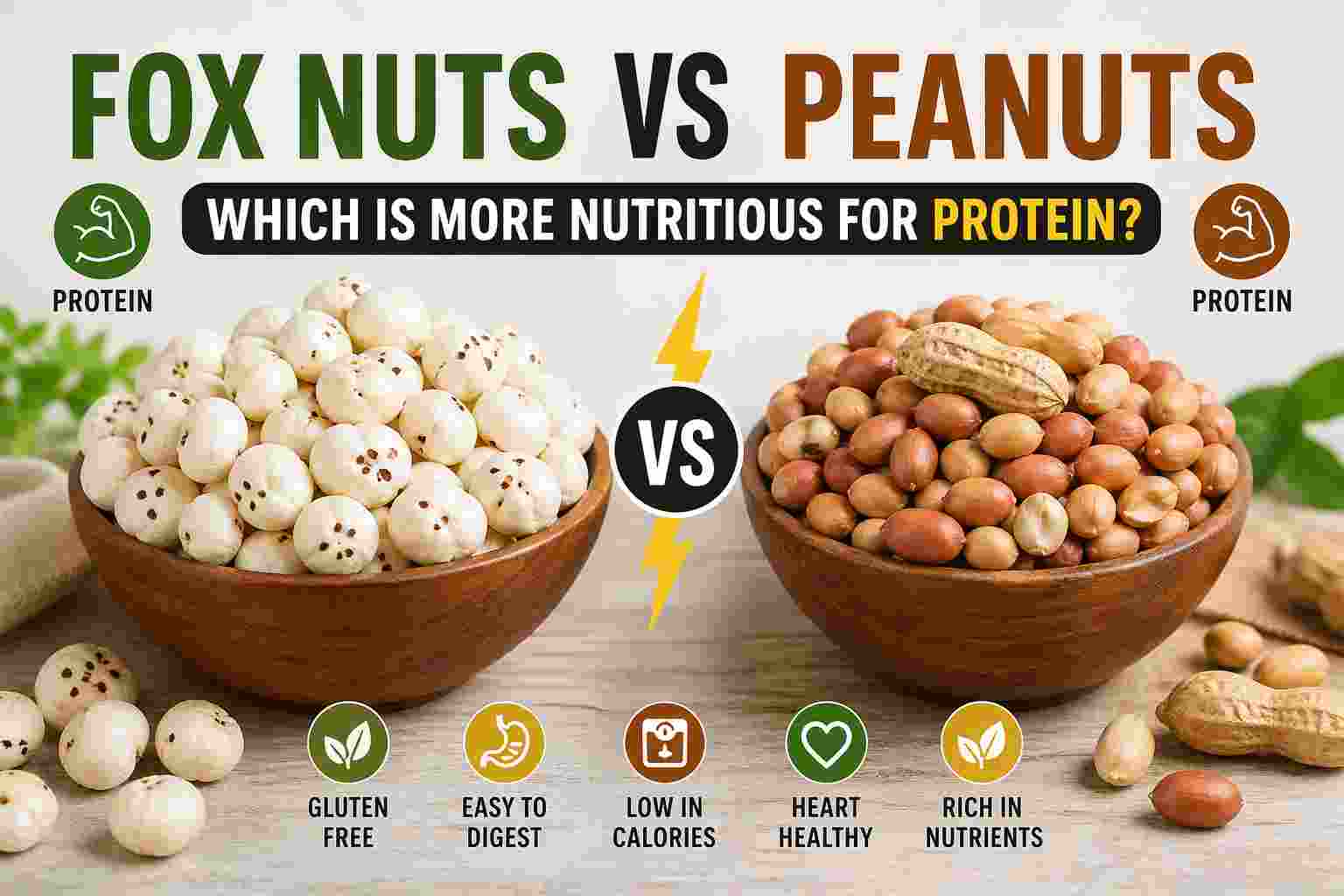
That distinction changes the answer to the headline question. If you mean which food gives you more protein, healthy fats, fiber, and research-backed cardiometabolic benefits, peanuts usually come out ahead. If you mean which snack lets you eat a larger-looking portion for fewer calories, fox nuts make a very strong case. And if you mean which one fits a low-allergen, lighter evening snack routine, fox nuts may be the smarter choice. The real winner depends on what job you want the snack to do.
The comparison that matters most
To keep this honest, I’m comparing plain fox nuts to plain dry-roasted peanuts without salt—not cheese-coated makhana, not honey-roasted peanuts, and not sweetened peanut butter spreads. For peanuts, I leaned on USDA FoodData Central data and related USDA-linked nutrition references. For fox nuts, I used peer-reviewed studies on popped and roasted Euryale ferox, then cross-checked practical advice about salt, sugar, and snack choice with guidance from Mayo Clinic and the FDA.
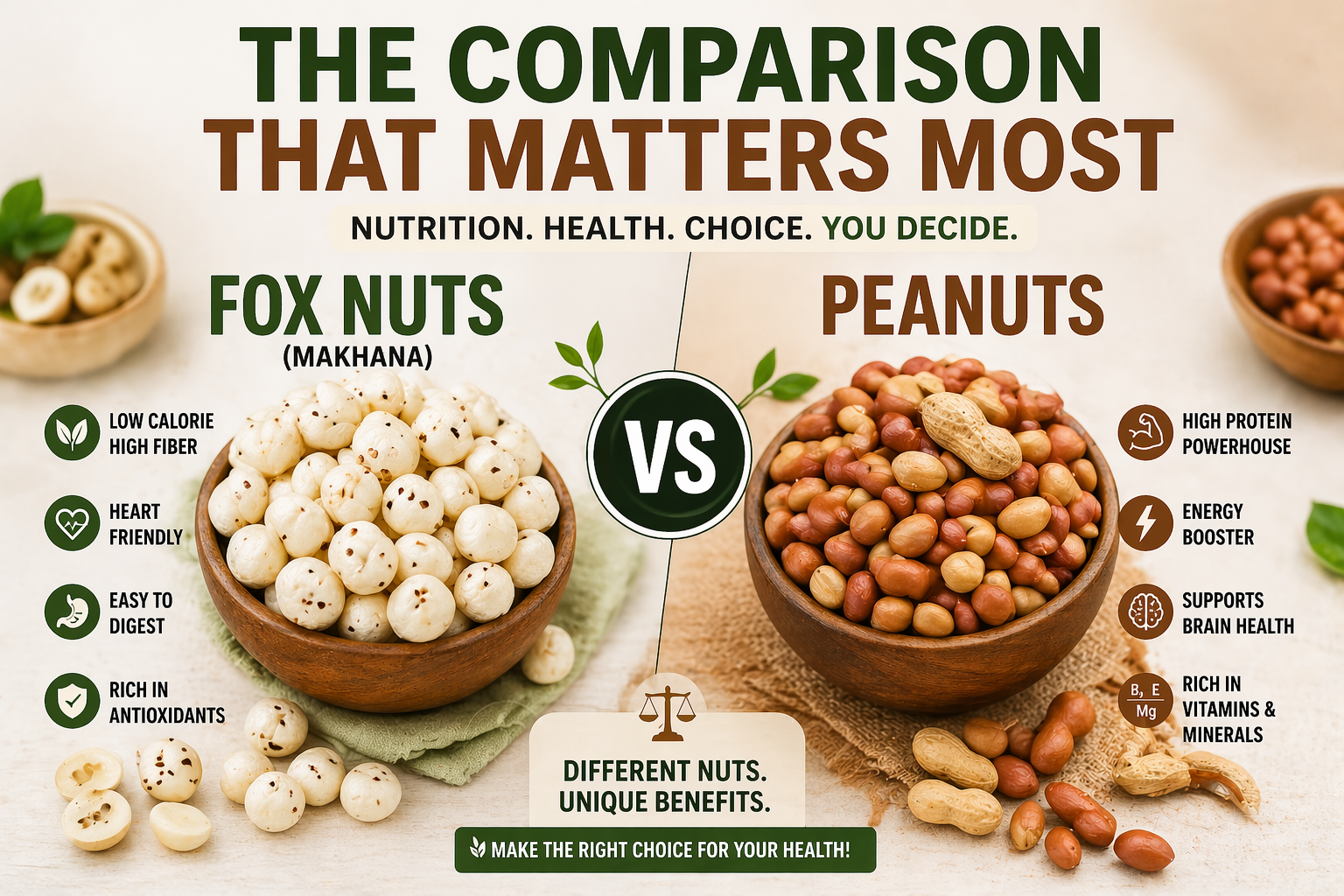
There are three lenses that matter here. The first is nutrition per 100 grams, which tells you how concentrated a food is. The second is nutrition per realistic snack portion, which matters more in real life because nobody casually eats 100 grams of fox nuts and 100 grams of peanuts the same way. The third is quality of evidence. A food can sound amazing in lab studies and still have much thinner evidence in humans than its reputation suggests. That last lens is where peanuts quietly gain ground.
Nutrition snapshot
| Metric | Plain fox nuts | Plain dry-roasted peanuts | What it means in practice |
|---|---|---|---|
| Calories per 100 g | about 354–382 kcal | about 585 kcal | Fox nuts are clearly lighter |
| Protein per 100 g | about 9–15 g | about 24 g | Peanuts deliver much more protein |
| Fat per 100 g | about 0.05–0.68 g | about 50 g | Peanuts are far richer in healthy fats |
| Carbs per 100 g | about 79 g | about 21.5 g | Fox nuts are primarily a starch-based snack |
| Approx. calories per 30 g portion | about 106–115 kcal | about 176 kcal | Fox nuts usually “cost” fewer calories per snack |
| Best nutritional use case | lighter, lower-fat crunch | protein-, fat-, and micronutrient-dense snack | They solve different problems |
| Human evidence base | promising but still limited | much stronger in cardiometabolic research | Peanuts have deeper research support |
Fox-nut values vary by processing method, so the range above combines published popped-seed and roasted-seed analyses. Peanut values are USDA-linked figures for plain dry-roasted peanuts without salt. Portion estimates are calculated from those source values.
This table is the clearest reality check. Fox nuts are not “bad” at all—but they are not a like-for-like nutritional substitute for peanuts if your priority is protein density. If you swap peanuts for fox nuts and expect similar protein, fat quality, or micronutrient payoff, the numbers do not support that expectation. On the other hand, if you are trying to build a larger-feeling snack for fewer calories, the fox nuts column starts to look very attractive.
Where fox nuts genuinely shine
Fox nuts win the volume game. Roasted fox nuts have a very low bulk density, which means a modest amount can fill a bowl and feel generous. One study reported a calorie density of about 382 kcal per 100 g after roasting, still much lower than dry-roasted peanuts at roughly 585 kcal per 100 g. That is why fox nuts often feel “lighter” even when you are eating a visually satisfying portion. This is not just psychology; it is the mathematics of low-fat, airy foods.
They also have a useful blood-sugar story. In a human glycemic-index study, roasted fox nuts came in at about 37, which places them in the low-GI range. The same paper found that roasting increased total phenolic content by about 36% and improved antioxidant activity. So fox nuts are not just empty puffed starch. They can be a smart option if you want something crunchy, relatively light, and gentler than many conventional packaged snacks like chips, candy, or sugary granola bars.
But here is the fresh perspective most “superfood” articles miss: fox nuts shine most when you judge them as a better alternative to ultra-processed snack foods, not when you force them into a head-to-head competition with nutrient-dense legumes or nuts. Much of the broader medicinal reputation around Euryale ferox still comes from in vitro and in vivo work, while the human evidence I found was much thinner, including a small GI study with 10 participants. That does not make the claims false; it means the evidence stack is still developing.
Where peanuts clearly pull ahead
Peanuts are much stronger on protein, healthy fats, and overall nutrient density. Published reviews describe peanuts as rich in protein, fiber, folate, niacin, magnesium, vitamin E, arginine, monounsaturated fats, and phytochemicals such as polyphenols and phytosterols. In USDA-linked nutrition data, dry-roasted peanuts without salt provide about 24 grams of protein and 8.4 grams of fiber per 100 grams—numbers that are simply in a different league from fox nuts on a gram-for-gram basis.
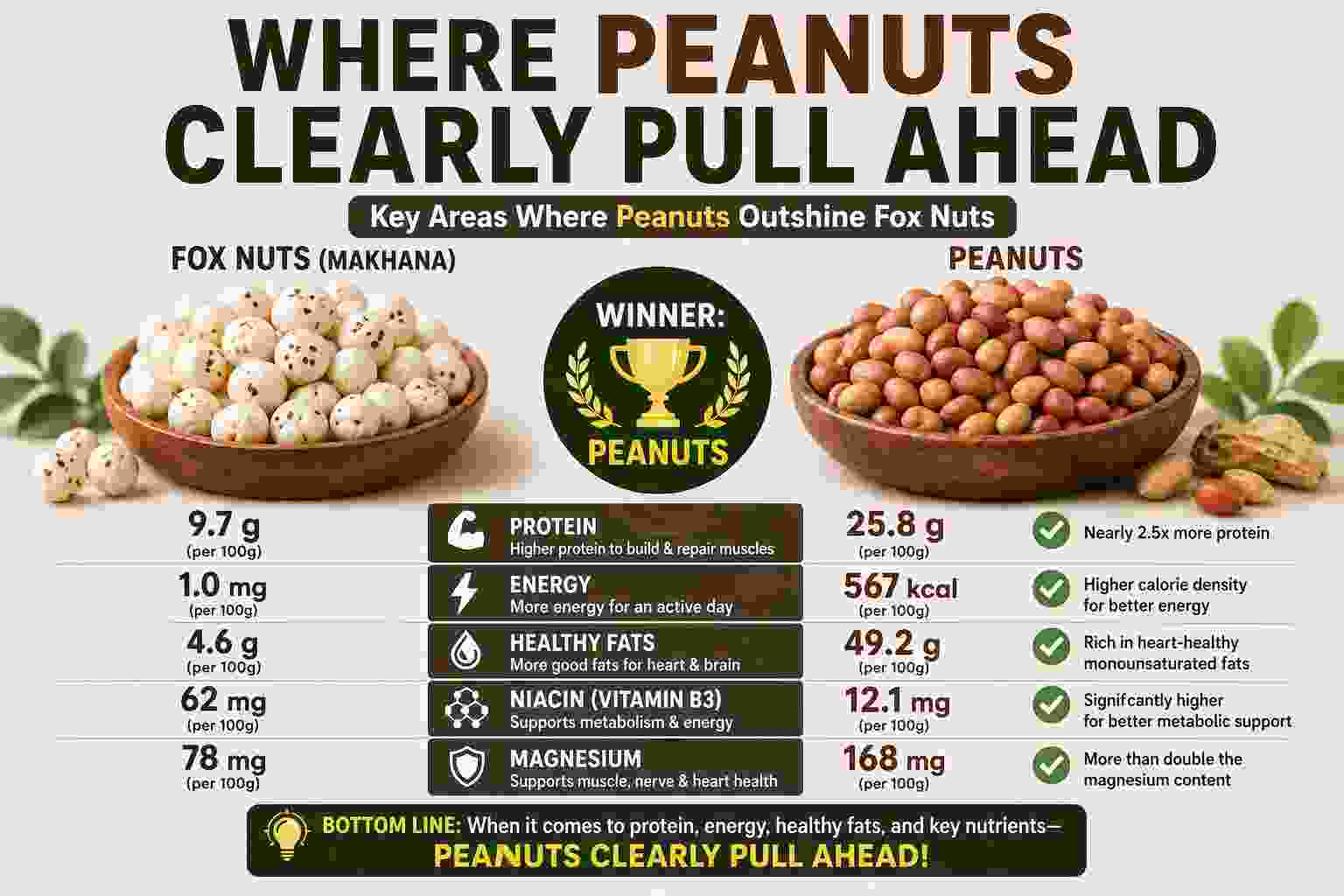
Peanuts also have a much stronger human evidence base behind their health halo. A 2022 randomized clinical trial and meta-analysis found that peanut consumption was associated with lower triglycerides, and in healthy participants it also improved cholesterol ratios. Broader reviews have linked higher nut intake—including peanuts—to lower cardiovascular disease risk, and researchers at Harvard T.H. Chan School of Public Health have highlighted evidence that regular intake of nuts, including peanuts, is associated with lower cardiovascular disease risk. That is a very different level of evidence from a promising small GI trial or cell-based antioxidant study.
There is a catch, of course. Peanuts are one of the FDA’s major food allergens, which immediately makes them a non-starter for some people. They are also among the foods susceptible to aflatoxins, which is why U.S. regulators test and regulate peanuts closely before they enter commerce. So peanuts may be more nutritious overall, but they also come with more food-safety and allergen baggage than fox nuts do. Nutrition is never only about nutrients. It is also about tolerance, safety, and context.
The detail most people miss
Processing changes this comparison fast. Mayo Clinic notes that adding salt or sugar to nuts can cancel out some of their heart-healthy benefits, and the FDA recommends choosing low-sodium or no-salt-added nuts, seeds, and snack products when possible. That advice applies just as much to fox nuts as it does to peanuts. A plain bowl of fox nuts is one thing; a ghee-heavy, masala-loaded, salty packaged version is another. The same goes for plain peanuts versus candy-coated or heavily salted peanuts.
This is where real-life snacking gets interesting. A 30-gram serving of fox nuts can give you the feeling of a proper snack bowl for roughly 106–115 calories. A 30-gram serving of peanuts is more like a small handful, but it brings far more protein and fat, which can help with fullness. Put simply, fox nuts are better when you want volume; peanuts are better when you want staying power. If your problem is “I want to keep munching,” fox nuts help. If your problem is “I need a snack that holds me until dinner,” peanuts usually do the better job. That is not marketing language. It is what the nutrition profile suggests.
The verdict for real-life snacking
If the question is “Which is more nutritious overall?”, peanuts win. They offer more protein, more fiber, more healthy fats, more meaningful micronutrient density, and much stronger human evidence for cardiometabolic benefits. Fox nuts are still a smart snack—but their strength is different. They are best understood as a lighter, lower-fat, low-GI, bigger-portion snack, not as a nutritional upgrade over peanuts.
The most useful conclusion is not to crown one food and banish the other. It is to use each strategically. Choose fox nuts when you want a lighter evening snack, a larger bowl, or a low-fat crunchy option. Choose peanuts when you want real nutrient density, better protein value, and stronger evidence-backed heart-health upside. And if you want the healthiest version of either, keep them as plain and unsweetened as possible. If you publish this piece, it pairs naturally with internal content on healthy Indian evening snacks, high-protein vegetarian snacks, and how to read packaged snack labels. Then ask your readers the only question that really decides the winner: do you want a bigger bowl, or a denser bite?
[…] as a true protein bar. For context, published composition data for popped Euryale ferox put fox nuts at about 358 kcal and 9.7% protein per 100 g, which works out to roughly 107 calories and about 3 g […]
[…] matters because the biggest benefit of fox nuts is often misunderstood. Their advantage is not that they are some wildly high-protein snack. […]