Fox Nuts Calories and Protein Guide
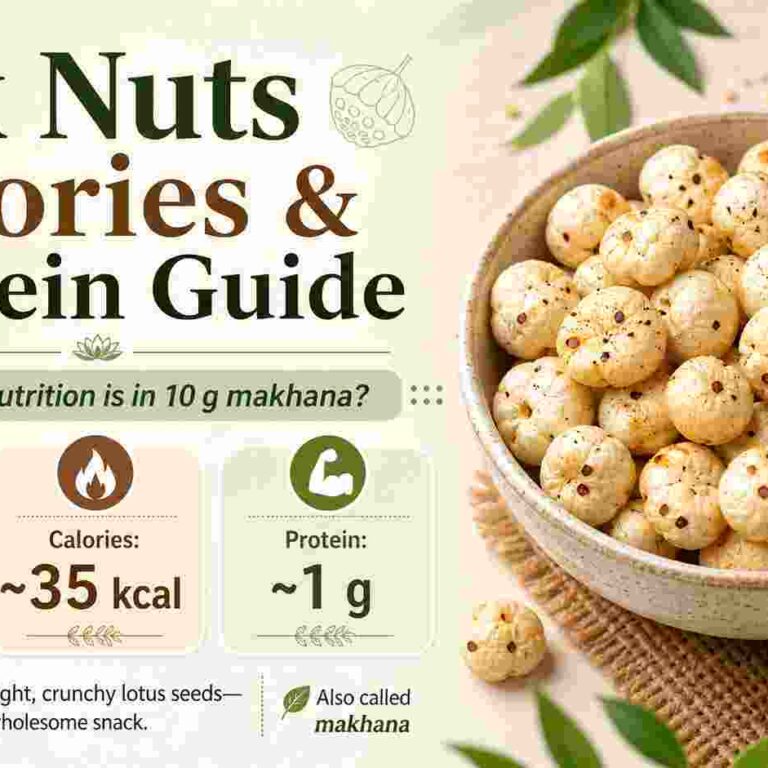
Introduction If you have ever finished a bowl of makhana and still felt like you made the “healthy” choice, you are not alone. Fox nuts have that rare snack magic: they feel light, crunchy, and almost too wholesome to count. But the most useful question is not whether makhana is “good” for you. It is much simpler: what do you actually get from 10 grams? For plain popped makhana, the practical answer is usually about 35 calories and roughly 1 gram of protein. That sounds tidy. But the real story behind fox nuts is even more interesting than most people think. There is also a fun twist hiding in the name. In everyday speech, people call makhana “fox nuts,” but a recent export study from APEDA notes that “fox nuts” and “lotus seeds” are botanically misleading labels for makhana. The snack’s modern success story still runs through Bihar, though: the same study says India accounts for about 90% of global supply, while Bihar contributes roughly 85–90% of India’s output. That context matters because makhana sits at the crossroads of tradition and modern snack marketing. It is sold as a fasting food, a clean-label pantry staple, a “superfood,” and sometimes even a protein snack. My own view is simpler: fox nuts are not magical, but they are genuinely useful. The trick is to stop treating them like an abstract health food and start reading them like a real snack—with real portions, real labels, and real trade-offs. The quick answer A handbook produced under the PMFME program by NIFTEM lists popped makhana at 358 kcal and 8.7 g protein per 100 g. Meanwhile, plain retail labels commonly cluster around 347–350 kcal and 9.7 g protein per 100 g. In other words, different sources do not match perfectly, but they agree closely enough for a practical takeaway: 10 g of plain popped fox nuts is usually around 35 calories and about 0.9–1.0 g of protein. Form of makhana Reference values per 100 g What that means for 10 g Best way to read it Plain popped fox nuts 347–350 kcal, 9.7 g protein 34.7–35.0 kcal, 0.97 g protein Closest to the everyday plain snack Popped makhana in institutional handbook 358 kcal, 8.7 g protein 35.8 kcal, 0.87 g protein A solid benchmark from an institutional source Raw makhana seed 259 kcal, 7.2 g protein 25.9 kcal, 0.72 g protein Useful for comparison, but not the usual ready-to-eat form Flavored roasted fox nuts 404–500 kcal, 8–10.5 g protein 40–50 kcal, 0.8–1.05 g protein Seasoning and added fat can change the story fast Source note: institutional values come from the foxnut handbook and retail-style values come from plain and flavored product labels surfaced in grocery listings. The spread is exactly why one neat “single number” for makhana can be misleading. So if your question is strictly, “How much are 10 grams of makhana calories and protein?” the most honest answer is this: plain popped fox nuts usually land at about 35 calories and around 1 gram of protein. If the pack is flavored, roasted with oil, or spice-coated, the calories can climb meaningfully even when the portion looks tiny. One more thing: 10 grams is small. A plain retail listing shows a 20 g serving size, which means a more realistic casual snack can be roughly 69–70 calories and about 1.9 g of protein before you even reach for a refill. That is why I think 10 g is best treated as a nutrition benchmark, not a satisfying end point. Comparison This is where fox nuts become genuinely interesting. They are not the protein champion of the snack shelf, but they are dramatically lower in fat than almonds or cashews. In the same APEDA comparison table, popped makhana contains 11.03 g protein and just 0.33 g fat per 100 g, while almonds have 18.41 g protein and 58.49 g fat, and cashews have 18.78 g protein and 45.2 g fat. That means fox nuts win less on protein density and more on “light crunch without the fat load.” Snack Protein in 10 g Fat in 10 g Carbs in 10 g What it means in practice Fox nuts 1.10 g 0.03 g 8.49 g Light, airy, low-fat crunch Popcorn 1.29 g 0.45 g 7.78 g Similar protein band, more fat and fiber Almonds 1.84 g 5.85 g 0.30 g More protein, but much richer Cashews 1.88 g 4.52 g 2.55 g More protein, still far higher in fat Source note: calculated from APEDA’s per-100 g comparison table for popped makhana, popcorn, almonds, and cashews. The comparison flips the usual marketing story on its head. If you buy fox nuts for protein alone, almonds and cashews are denser options. If you buy them because you want a big-looking snack that does not bring much fat with it, fox nuts make a very strong case. Compared with popcorn, they sit in a surprisingly similar protein range on a 10 g basis, but the APEDA table shows plain popped makhana with a lower fat figure. That is the fresh perspective many blog posts miss: fox nuts are not impressive because they are secretly muscle food. They are impressive because they create a feeling of volume and crunch while staying relatively restrained on fat when plain. That is a different kind of snack advantage—and honestly, a more useful one for everyday eating. Key insights The first key insight is that protein reputation and protein reality are not the same thing. A label that says 9–11 g protein per 100 g sounds strong, but most people do not sit down with 100 g of makhana unless they are sharing a very large bowl. On a more normal scale, 20 g of plain fox nuts is only about 1.9 g protein, and 30 g is still only around 2.9–3.0 g using plain-label values. In practical diet terms, that is modest protein, not high protein. The second insight is that processing changes the nutrition story more than people assume. The institutional handbook from NIFTEM lists raw makhana seed at 259 kcal per 100 g and popped makhana at 358 kcal per 100 g, while also showing a jump in carbohydrates and a shift in moisture. On top of that,