
Fox-nuts-benefits-for-female

Fox Nuts Benefits for Female

Introduction

If you’ve ever stood in front of the pantry thinking “I want something crunchy… but I don’t want to feel heavy or guilty after,” you’re not alone. That exact moment—between hunger and habit—is where Fox Nuts can quietly become a game-changer. 
Fox-nuts-benefits-for-female

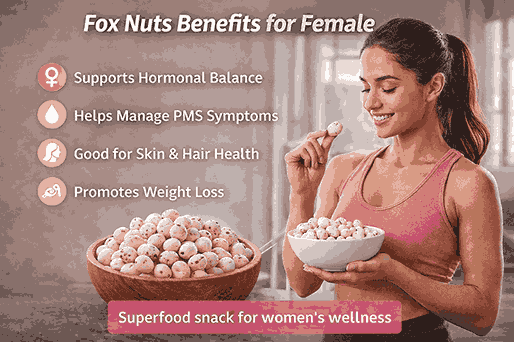
Fox Nuts (also called makhana/phool makhana) sit in a rare sweet spot: they’re light, snackable, and surprisingly nutrient-dense for how “airy” they feel. And for women—whose nutrition needs shift across the menstrual cycle, pregnancy, postpartum, and menopause—small, repeatable snack upgrades can make a bigger difference than chasing one “perfect” superfood. 

Before we get to benefits, one quick clarity point that most blog posts skip: you’ll often see makhana labeled “lotus seeds.” They’re frequently confused with true lotus seeds; a widely read piece from Down To Earth explains that lotus seeds come from Nelumbo nucifera, while fox nuts/makhana are from the prickly water lily (Euryale ferox) and are typically roasted/popped before eating. 

Comparison

Fox Nuts aren’t “better” than every snack in every scenario. They’re better at specific jobs—especially the ones many women care about: managing cravings, avoiding blood-sugar whiplash, and adding minerals without adding a ton of oil. 

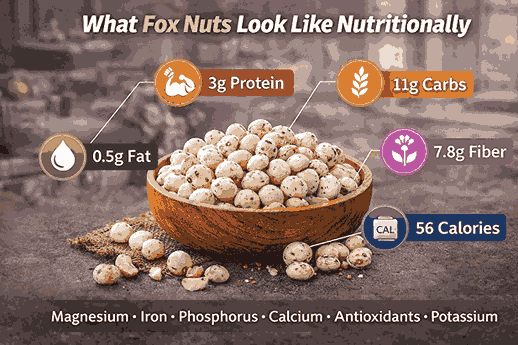
What Fox Nuts look like nutritionally

A serving example cited by Healthline: one cup (32 g) of dried lotus seeds/makhana provides about 106 calories and 4.93 g protein, plus minerals like calcium (52.2 mg) and magnesium (67.2 mg)

Fox-nuts-benefits-for-female

A key nuance: how you prepare them changes the math. A human study on roasted fox nuts reported that roasting decreased bulk density and increased calorie density (partly because moisture drops), which matters if you snack by “handfuls” instead of measuring. 

Fox Nuts vs common snacks

This table isn’t here to crown a winner—it’s here to make trade-offs obvious.

Snack (typical serving)CaloriesProteinFatWhat this means for women
Fox Nuts / makhana (1 cup / 32 g)~106~4.93 gNoted as low-fat in this servingMore “volume per bite,” helpful for crunchy cravings; includes minerals like magnesium/calcium. 
Air-popped popcorn (1 cup)~31~1.04 g~0.36 gVery low-calorie per cup; can be a great “volume snack,” but usually less mineral-dense and easy to over-salt. 
Almonds (1 oz / 28 g)~164~6 g~14.2 gHigher protein and healthy fats; more calorically dense—great when you need satiety, less ideal if you snack mindlessly. 
Potato chips (1 oz)~155~1.86 g~10.62 gDesigned for “crave + repeat.” Higher fat and typically high sodium; easy to overshoot without feeling full. 

The most underrated comparison: glycemic response

In a small human trial (n=10), roasted fox nuts had a glycemic index around 37, which falls in the “low GI” category (GI < 55). 

That matters because many women notice their appetite and energy feel different when snacks spike glucose and crash later—particularly in phases like late luteal/PMS, during perimenopause, or when managing insulin resistance. (Fox nuts aren’t a cure—but low-GI snack patterns can be a practical lever.) 

Key insights

A “snack job” Fox Nuts do well: crunchy cravings without the oil load

A lot of women don’t actually crave food—they crave the experience of crunch, salt, and “something to do with my hands.” Fox nuts match that sensory profile while staying relatively light compared with fried snacks. 

Here’s the fresh perspective I’d offer: think of Fox Nuts as a craving container. They let you keep the ritual (crunch + spice + downtime) while changing the nutritional outcome.

What helps this work in real life is how you season them. The same study that measured GI also did consumer acceptability testing and found seasoning improved “liking,” which matters because a “healthy snack” you don’t enjoy won’t become a habit. 

Minerals that show up in women’s health conversations: magnesium and calcium

Magnesium isn’t a trendy add-on; it’s a core mineral involved in hundreds of enzyme systems, including muscle and nerve function and blood glucose regulation. 

For adult women, magnesium RDAs are commonly 310–320 mg/day (and higher in pregnancy depending on age). 
A 1-cup serving of makhana in the example above provides ~67 mg magnesium—not “magic,” but meaningful as part of a day’s intake. 

Calcium matters too, especially because requirements shift with age and because postmenopausal women are specifically noted as a group that can have more trouble maintaining calcium balance over time. 
Adults commonly need around 1,000 mg/day, while women ages 51–70 are listed at 1,200 mg/day in consumer guidance. 
Makhana’s calcium contribution (about 52 mg per cup in the example) is modest—but it’s additive, particularly for women who don’t eat much dairy. 

A careful but useful connection: nutrition research reviews in gynecologic contexts often discuss minerals (including magnesium, sometimes alongside calcium and vitamin D) in relation to menstrual symptom strategies—but effects vary by study, dose, and population, and supplement-level doses differ from food-level intake. That’s why Fox Nuts are best framed as foundation support, not treatment. 

Iron, energy, and “why women feel tired” is bigger than one snack

If there’s one mineral that makes the question “benefits for female?” feel uniquely female, it’s iron.

The Office of Dietary Supplements lists that teenage girls, pregnant women, and premenopausal women are among groups at risk of insufficient iron intake, and it also notes that heavy menstrual bleeding increases iron-deficiency risk. 

It also gives the reality check on targets: women ages 19–50: 18 mg/day, and pregnancy: 27 mg/day

Fox nuts contain some iron (about 1.13 mg per cup in the cited example), which is roughly a small single-digit percentage of daily needs for many women—helpful, but not enough to “fix” low iron by itself. 

Two practical takeaways that do move the needle:

  • Plant-based (non-heme) iron absorption is affected by other dietary factors; the ODS notes components like ascorbic acid can influence bioavailability. 
  • If you’re relying mostly on plant foods, iron requirements can effectively be higher because non-heme iron is less bioavailable than heme iron. 

So the “female benefit” here is not that Fox Nuts are an iron supplement—it’s that they can be part of an iron-aware snack strategy (more on that below). 

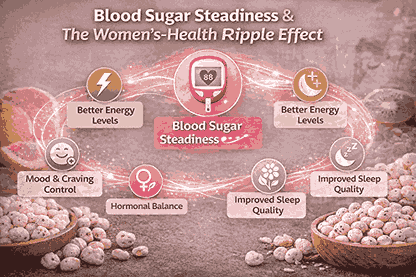
Blood sugar steadiness and the women’s-health ripple effect

The human GI finding (GI ~37 for roasted fox nuts) is one of the more concrete, non-hand-wavy data points in the makhana conversation. 
Fox-nuts-benefits-for-female

Why it’s relevant for women specifically:

  • Women are disproportionately navigating life stages that reshape glucose regulation and appetite cues (pregnancy, postpartum sleep disruption, perimenopause). 
  • Many women also manage conditions where glucose stability matters (for example, insulin resistance patterns), and a low-GI snack can be a “no-drama” swap. 

Important honesty: a lot of “fox nut benefits” content leans on animal or extract studies. Even Healthline notes that some blood-sugar findings come from animal research using concentrated extracts, and more human research is needed for typical dietary intakes. 

So, the clean claim you can make is: Fox Nuts can be a low-GI snack option when roasted plainly, which may fit into blood-sugar-friendly eating patterns. 

Antioxidants: promising, but don’t let the word do all the work

Fox nuts contain phenolics and flavonoids, and roasting can increase measured phenolic content and antioxidant activity in lab assays—shown clearly in the same paper that measured GI. 

A broader scientific review also describes Euryale ferox seeds as containing nutrients and bioactive compounds and discusses their potential functional-food relevance. 

The “fresh perspective” here: antioxidants matter most when they help you eat more whole foods consistently. If Fox Nuts replace ultra-processed snacks in your daily routine, the benefit doesn’t come only from a specific polyphenol—it comes from the pattern change plus the nutrients. 

How to make Fox Nuts work for you

The biggest mistake people make with Fox Nuts is treating them like popcorn: eating straight from the bag until the crunch disappears.

Instead, build a “Fox Nuts formula” based on your goal:

If your goal is cravings and weight management

Use Fox Nuts as the crunchy base, but keep the added fat intentional (because roasting can raise calorie density as moisture drops). 

Try:
Dry roast + spice blend (turmeric + black pepper + chili + pinch of salt).
Make a bowl, not a bag. The ritual matters.

Internal link suggestion: If you’re building a snack routine, link to a post like “Healthy evening snacks that don’t spike cravings” (example slug: /healthy-evening-snacks).

If your goal is steadier blood sugar

Lean into the low-GI benefit by pairing Fox Nuts with protein or fat—because carbs alone (even low GI) can still leave you hungry later. 

Try:
Fox Nuts + Greek yogurt (or curd) + cinnamon
Or
Fox Nuts + a handful of nuts (this blends volume with satiety). 

Internal link suggestion: “High-protein vegetarian snacks for women” (example slug: /high-protein-vegetarian-snacks).

If your goal is iron support (especially around heavy periods)

Remember: Fox Nuts contribute some iron, but they won’t cover female iron RDAs alone. 

Make the snack more “iron-smart”:

  • Add a vitamin C source on the side (think lemon, guava, amla, strawberries) to support non-heme iron absorption patterns described in nutrition guidance. 
  • Keep tea/coffee away from iron-heavy meals if you’re actively managing iron (polyphenols can inhibit absorption—discuss this with your clinician if iron deficiency is a concern). 

Conclusion and call-to-action

The most honest answer to “Fox Nuts benefits for female?” is this: Fox Nuts help when they replace something else. They’re a practical, enjoyable swap that can support women’s real-life goals—crunchy cravings, steadier blood sugar, and small but meaningful contributions of minerals like magnesium and calcium—without pretending to be a cure-all. 

CTA: What’s your hardest snack moment—afternoon slump, late-night cravings, or period-week hunger? Share it in the comments, and subscribe for more evidence-backed, women-focused snack and nutrition guides.
Makhana-vs-Fox-Nuts

Makhana vs Fox Nut: What’s the Difference?

Introduction

A funny thing happens the moment you start buying makhana regularly: you notice it’s having an identity crisis.

Makhana-vs-Fox-Nuts
Makhana-vs-Fox-Nuts

One packet says “Makhana”, another says “Fox Nuts”, a third says “Lotus Seeds”—and suddenly you’re standing in the snack aisle wondering if you’ve been eating three different foods… or the same one in three different costumes. (I’ve been there. The first time I tried to “research” it, I ended up with five tabs open and more confusion than before.)

So let’s settle it properly—with the botany, the food science, and the real-world “what does this label actually mean?” perspective—without turning it into a textbook.

The quick answer

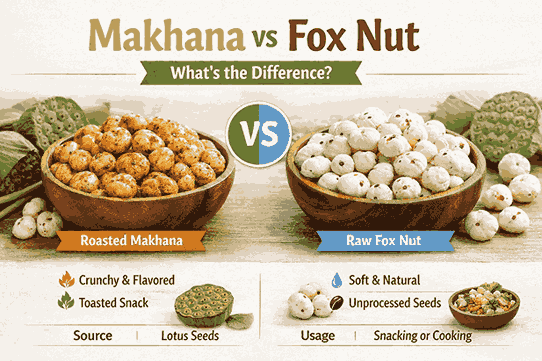
In most everyday shopping and cooking contexts, fox nut and makhana refer to the same thing: the edible seed of the aquatic plant Euryale ferox—often sold in a puffed/popped form that looks like tiny white popcorn. 

Where the confusion sneaks in is how people use the words:

  • “Fox nuts” is commonly used as an English common name for the seeds. 
  • “Makhana” is widely used in South Asia (especially in India) and, in trade/food standards, it often implies the processed form—roasted/popped seeds with the outer covering removed. 

In other words: same botanical source, but the label sometimes hints at the form or processing

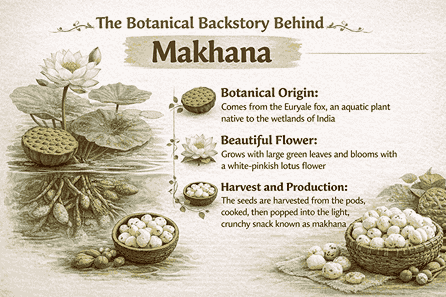
The botanical backstory behind makhana

Makhana-vs-Fox-Nuts

If you only remember one scientific detail, make it this: makhana/fox nuts come from Euryale ferox—an aquatic plant in the water lily family (Nymphaeaceae). 

A practical way to visualize it:

  • The plant grows in freshwater bodies (ponds, shallow water systems). 
  • The seeds are harvested and then roasted—and that roasting is what makes them puff “like popcorn,” which is why fox nuts feels like a snack rather than a “seed” in your head. 

Here’s the extra nuance that most quick blog posts miss: in formal Indian food terminology, “makhanna/makhana” is not just “a seed,” it’s a product form.

A classic Indian standard (IS 3155:1965) describes “MAKHANNA” as the product obtained by roasting seeds from Euryale ferox and removing the outer black covering as much as possible

That explains why some people (especially in food processing or trade circles) speak as if:

  • “fox nut” = the seed (raw identity)
  • “makhana” = the roasted/popped edible product (snack identity) 

Comparison that actually matters

A lot of “difference” articles stop at “they’re the same.” True—but incomplete. The useful comparison is how the terms signal formkitchen use, and what you’ll get if you order it in different markets.

Term you’ll seeWhat it usually refers toBotanical sourceTypical form you receiveMost common culinary use
makhanaOften the processed, edible productEuryale feroxUsually popped/expanded white puffsDry roasting & seasoning; also sweets like kheer 
fox nutsBroad English common name; sometimes same as makhanaEuryale feroxEither popped snack (like makhana) or dried kernels in some marketsSnack form or cooked into soups/porridge depending on cuisine 
gorgon nutAnother common/trade nameEuryale feroxRefers to the seed; may be sold dried before poppingIngredient use; can be processed into popped form 
lotus seeddifferent food that gets confused with makhanaNelumbo nuciferaLarger, smooth, often sold dried/shelledDesserts, seed paste, soups; can be eaten raw or dried 

This table is based on botanical descriptions and processing definitions from university/peer-reviewed sources and food standards. 

Key insights you rarely see on the label

The “lotus seed” mix-up is real—and it changes what you’re buying

Let’s be blunt: makhana is not lotus seed in the botanical sense, even though many packages and wellness articles casually blend the terms. 

  • Lotus seeds come from Nelumbo nucifera (true lotus). 
  • Makhana/fox nuts come from Euryale ferox (prickly water lily/gorgon plant). 

A tip I wish someone had told me earlier: if you’re buying for texture, this matters.

  • The snack most people love as “makhana” is loved because it’s light and puffed—that comes from the way Euryale ferox seeds are processed to pop. 
  • Lotus seeds, meanwhile, are commonly used in desserts and fillings (and yes, they can be eaten in different forms), but they’re not automatically the same “popcorn-like” snack you’re expecting when you buy makhana. 

Fast label-reading test:
Look for the botanical name.

  • If it says Euryale ferox → you’re in makhana/fox nut territory. 
  • If it says Nelumbo nucifera → lotus seed. 

Nutrition nuance: makhana is “light” in volume, not “low calorie” by default

Makhana is often described online as a “light snack.” That’s emotionally true—and sometimes nutritionally misleading.

What the data consistently shows is this: popped makhana is high in carbohydrates and low in fat, with moderate protein. 

For example, one processing handbook reports popped makhana around 79.8% carbohydrate8.7% protein, and 0.5% fat, with a calorific value listed at 358 kcal per 100 g (values vary by moisture and processing). 
A broader technical review also summarizes raw seeds at about 76.9% carbohydrate, 9.7% protein, and 0.1% fat, again showing a similar “starchy seed, low fat” profile. 

Here’s the real-life takeaway (the one that actually helps you snack smarter):

  • A big bowl looks like a lot, because makhana is airy.
  • But calories depend on what you add: roasting in ghee/oil and seasoning can change the snack from “light, crunchy” to “calorie-dense” quickly. 

Why makhana behaves differently from nuts in digestion and cooking

Even when people call them “nuts,” fox nuts/makhana are starch-forward seeds, not oil-rich nuts like almonds or cashews—hence the popcorn-like puffing behavior. 

That starch angle is also why researchers keep studying resistant starch and digestibility in Euryale ferox:

  • A PubMed-indexed study looked at increasing resistant starch content in popped makhana to address rapid starch digestibility and glycemic response concerns. 
  • Food science work has also used Euryale ferox starch to prepare type-3 resistant starch (RS3), a form associated with slower digestion in general starch science. 

If you’ve ever wondered why makhana can feel more like “a crunchy carb snack” than “a handful of nuts,” that’s why.

Sourcing matters because it’s an aquatic crop

This is the perspective that shifted the way I buy makhana: it’s not just a snack; it’s an aquatic crop, and aquatic plants can reflect their growing environment. 

A well-cited study found that toxic metal contents in Euryale ferox seeds were positively correlated with metal concentrations in the surrounding water and sediments (in the study’s context), raising a clear “water quality matters” point. 

That doesn’t mean “avoid makhana.” It means buy from suppliers who care about sourcing and testing, especially if you consume it frequently.

Makhana isn’t just a “new superfood”—it has serious economic and regulatory weight

Makhana’s popularity isn’t only Instagram-driven; it’s backed by production systems, standards, and even international approvals.

  • A processing handbook describes harvesting as manual collection (including diving in water bodies) and provides production estimates, noting that Bihar is the leading state and is estimated to account for more than 80% of India’s makhana production. 
  • A statement in Press Information Bureau notes that Darbhanga (and the Mithila area more broadly) is a major producing region, in the context of the National Research Centre for Makhana and its mandate. 
  • In 2022, news reporting on GI registration noted that “Mithila Makhana” was registered with a GI tag. 
  • The European Commission authorised roasted and popped kernels from Euryale ferox (makhana) as a “traditional food from a third country,” and even specifies acceptable naming on labels (e.g., “roasted seeds of Euryale ferox” or “makhana (Euryale ferox) roasted seeds”). 
  • A 2025 release from Press Information Bureau also highlights export momentum, describing a GI-tagged Mithila Makhana consignment being flagged off and referencing support through Agricultural and Processed Food Products Export Development Authority. 

How I buy and cook makhana at home

This is the part you came for if you’re a practical reader (hello, fellow snack optimizer).

Buying checklist I actually use

I keep it simple:

  • Check the botanical name when possible. I prefer Euryale ferox clearly stated so there’s no lotus-seed confusion. 
  • Choose a reasonable grade for your use-case. Larger, fully expanded puffs tend to feel more premium for snacking, while smaller/irregular pieces can be perfect for kheer, curries, or grinding into flour. 
  • Buy from brands/sellers you trust, because cultivation and harvesting are tied to water systems. 

My go-to roasting method

I used to burn makhana because I treated it like popcorn. The trick is gentler.

What works for me:

  1. Heat a pan on low-medium.
  2. Add a small amount of fat (or dry roast).
  3. Stir constantly for several minutes until it turns crisp (you’ll hear a subtle change in sound).
  4. Season at the end.

Roasting/processing is central to what makhana is as a product (that’s literally how older standards define it). 

How I use it beyond “movie snack”

If your only mental model is “spiced makhana in a bowl,” try these:

  • Kheer: Many sources note its use in porridge/pudding-style preparations, especially in India. 
  • Curries and gravies: It’s used in traditional dishes (often as a texture element). 
  • Soup/porridge in Chinese cuisine traditions: Separate from the popped snack form, dried kernels are used in soups and are discussed in ethnobotanical and review literature. 

Frequently Asked Questions (FAQs)

1. Is makhana the same as fox nut?

Yes, makhana and fox nuts refer to the same food. “Makhana” is the commonly used name in India, while “fox nuts” is the English term used globally for the seeds of the lotus plant.


2. Why are they called fox nuts?

The name “fox nut” comes from the plant species Euryale ferox. The word “ferox” means fierce or strong, which eventually led to the term “fox nut” in English.


3. Is there any difference in taste between makhana and fox nuts?

No, there is no difference in taste. Both names describe the same popped seed, which has a mild, slightly nutty flavor that easily absorbs seasonings.


4. Are makhana and fox nuts grown in different regions?

Not really. Most makhana (fox nuts) are cultivated in India, especially in Bihar. The difference lies only in naming, not in origin or production.


5. Which term is better for SEO: makhana or fox nuts?

Both keywords are useful. “Fox nuts” has higher global search volume, while “makhana” is more popular in India. Using both together in your content can improve reach.

Conclusion and CTA

So—what’s the difference between fox nut and makhana?

Most of the time, none in the botanical sense: both point back to Euryale ferox
The real “difference” is a language-and-processing story: “fox nut” is the common English name for the seed, while “makhana” often signals the roasted/popped product form people snack on. 

And the smartest thing you can do as a buyer is stop relying on nicknames and start relying on the botanical name—especially to avoid the lotus-seed mix-up. 

Your turn: Have you seen makhana labeled as “lotus seeds” where you live—or do you use “fox nuts” and “makhana” differently in your kitchen? Share your experience (and your favorite seasoning combo), and if you found this helpful, pass it on to the one friend who still thinks makhana is an actual nut.