Basic

makhana-fox-nuts
Basic

Makhana: The Ancient Fox Nut Earning Today’s “Superfood” Status
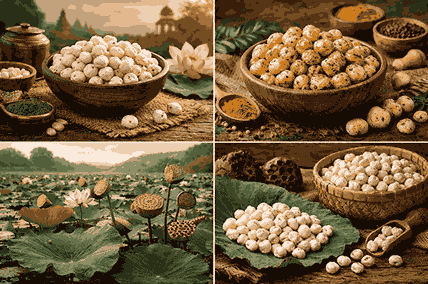
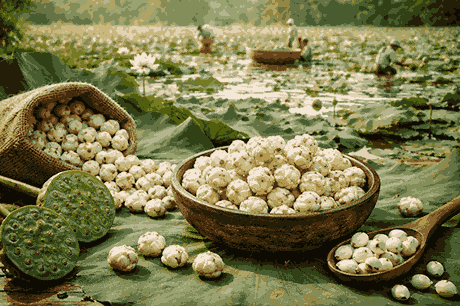
The puffed white seeds called makhana (fox nuts) are harvested from water lilies and enjoyed roasted as a crunchy snack. Once a humble ritual food in India, makhana (Euryale ferox seeds) has surged in popularity globally. Often mislabeled “lotus seeds,” these are actually the popped kernels of a prickly water lily plant. In recent years nutritionists and food bloggers have touted fox nuts as a nutrient-dense superfood – but what earned it this title? This post digs deep into makhana’s background, nutrients, and benefits, explaining why it’s more than just a tasty snack. What Is Makhana? Origins and Cultural Roots Makhana (also called fox nut, gorgon nut or phool makhana) has been cultivated for centuries in wetlands of Bihar (Mithila) in India, as well as parts of China, Japan and Korea. In Bihar it’s sometimes dubbed the “black diamond” due to its high value and labor-intensive harvest. The seeds come from the water lily Euryale ferox, not the lotus, which explains why they sometimes get confusingly called “lotus seeds.” When the ripe seeds are collected, the outer coating is removed, and the inner kernel (perisperm) is sun-dried and roasted until it puffs up (similar to popcorn). The result is a crunchy white puff with a mild, nutty flavor that graces festival feasts, fasting menus, and modern recipes alike. In traditional cultures, makhana has a strong heritage. Ayurvedic and Chinese medicine texts praised the nutritious quality of E. ferox seeds. Chinese herbal lore calls it a “medicine-food homology species,” used for thousands of years as both food and remedy. Indian rituals have long featured makhana: it’s offered in puja ceremonies and used in sweets like kheer or panjiri. This cultural cachet helped makhana survive as a staple snack in eastern India. In fact, references date back 2000 years – in China it’s called a “superior food” valued for antioxidants and blood-sugar benefits, and in India the word makhana comes from Sanskrit (“makh” = ritual, “anna” = food). By mid-20th century, makhana was mainly a local delicacy. But over the last decade its profile changed. Urban consumers seeking healthy alternatives to chips embraced makhana as a low-fat, high-protein snack. Nutrition experts and wellness influencers started promoting it as a superfood, leading to store shelves being stocked with a variety of roasted and flavored fox nuts.. In 2022, India even won a Geographical Indication tag for “Mithila Makhana”, and the seeds were served at the 2023 G20 summit – cementing makhana’s international spotlight. Today Bihar still produces >80% of the world’s makhana, and exports are rising rapidly, driven by growing demand in health-food markets worldwide. Nutritional Profile: A Powerhouse of Nutrients Makhana’s “superfood” label stems largely from its impressive nutrient density. In a small 32 g cup of popped makhana (about 106 calories), you’ll find roughly 5 g of protein, 4.4 g fiber, and a variety of minerals. 100 g of makhana provides roughly 347 calories, 9.7 g protein, and 14.5 g fiber – much higher protein and fiber than other starchy snacks. It contains significant calcium, magnesium, and potassium (roughly 60–70 mg each per 100 g) and small amounts of iron and zinc. Notably, makhana is extremely low in fat (only ~0.1 g per 100 g) and very low in sodium when unseasoned. The seed’s macronutrient breakdown is mostly complex carbohydrates (around 61–77% of its weight, depending on raw vs popped form). Its protein is plant-based and well-rounded: one analysis notes makhana includes all nine essential amino acids, a rarity among grains. Its starches and dietary fiber are digested slowly, contributing to a low glycemic index. Indeed, most sources list makhana’s GI around 30–55, lower than rice or regular grains, which means it causes a gentler rise in blood sugar. The chart below compares makhana to common snacks/staples: Nutrient Makhana (100 g, popped) Air-Popped Popcorn (100 g) White Rice, cooked (100 g) Calories 347 387 129 Protein 9.7 g 12.94 g 2.66 g Fat 0.1 g 4.54 g 0.28 g Carbs 76.9 g 77.78 g 27.9 g Fiber 14.5 g 14.5 g 0.4 g This comparison highlights key points: Per calorie, makhana packs more protein and fiber than cooked rice and almost as much fiber as popcorn, with far less fat than either. Unlike popcorn or chips, makhana’s crunch comes with minimal oil. Nutritionists note that 100 g of fox nuts has nearly zero saturated fat and no cholesterol, making it a heart-healthy snack choice. And compared to nuts like almonds, fox nuts has far fewer calories and fat while still providing protein (about 10 g per 100 g). In short, each bite delivers vitamins and minerals along with beneficial plant protein and fiber. Health Benefits: Why Makhana Can Be a “Super” Snack 1. High in Protein and Fiber. The combination of protein and fiber makes fox nuts filling and nutritious. Protein helps build and repair tissues, and contributes to satiety, while fiber supports digestion. One study notes that adding 100 g of fox nuts provides a solid protein boost with very low fat. This helps curb hunger and can aid weight management. In fact, Indian nutritionists emphasize makhana’s role in weight control: its high fiber and low-calorie nature mean you feel full on fewer calories 2. Rich in Minerals. A single serving of makhana brings in minerals often lacking in modern diets. It is a good source of magnesium and potassium, both vital for heart health and blood pressure regulation. For example, the magnesium (Mg) in makhana helps muscle and nerve function and may lower blood pressure. Potassium (K) aids in controlling heart rhythm and fluid balance. Not surprisingly, healthcare experts list makhana as beneficial for those concerned about hypertension or heart disease. It also contains calcium and phosphorus for strong bones, plus trace iron to support red blood cells. Harvested makhana seeds (below) are white when puffed and naturally low in salt and fat. Roasting them with spices creates a crunchy snack. The abundance of minerals and phytonutrients gives makhana antioxidant properties too. Studies show the seeds contain flavonoids and polyphenols like kaempferol, gallic acid, and ellagic acid. These antioxidants neutralize free radicals in the body, which can reduce inflammation and may protect against chronic diseases like heart disease and cancer. In fact, diets rich

makahan-fox-nuts
Basic

Where Are Fox Nuts (Makhana) Grown in India? The Untold Story Behind India’s

Introduction: The Hidden Journey of Makhana If you’ve ever enjoyed a bowl of crunchy makhana, you might have wondered—where does this unique snack actually come from? Unlike almonds or peanuts, fox nuts doesn’t grow on trees or underground. It comes from water. Yes, the humble fox nut (makhana) is an aquatic crop, deeply rooted in India’s traditional farming systems. India is not just a producer—it’s the global leader in fox nuts cultivation, contributing nearly 80–90% of the world’s supply. And at the heart of this industry lies one state: Bihar. But the story doesn’t end there. Let’s explore where fox nuts is grown in India, why certain regions dominate, and how this ancient crop is shaping livelihoods today. Where Is Makhana Grown in India? (Core Regions Explained) 1. Bihar – The Primary Source of Makhana in India When we talk about fox nuts, Bihar is the undisputed king. These regions fall under the Mithila belt, where natural wetlands and ponds create the perfect ecosystem for fox nuts cultivation. Why Bihar dominates: Fun insight: fox nuts farming here is not just agriculture—it’s a cultural identity. Many families have been cultivating it for decades. 2. West Bengal – The Emerging Player West Bengal is slowly becoming a strong contributor to fox nuts production. Why it works: 3. Assam & Northeast India – Untapped Potential The Northeast has huge potential but remains underutilized. Advantages: Challenges: 4. Eastern Uttar Pradesh – Small but Growing Some districts in eastern UP are experimenting with makhana farming: This region shares similar climatic conditions with Bihar, making it suitable for expansion. Comparison: Makhana Growing Regions in India Region Production Share Key Strength Growth Potential Bihar ⭐⭐⭐⭐⭐ (~80%) Expertise + natural wetlands High West Bengal ⭐⭐⭐ Similar geography + support High Assam/Northeast ⭐⭐ Untapped water resources Very High Uttar Pradesh ⭐⭐ Expanding cultivation Moderate Why Makhana Grows Only in Specific Regions? Not every place can grow fox nuts. It requires very specific conditions: Climate Requirements Water Conditions Soil Type This is why regions like Rajasthan or Punjab are not suitable for fox nuts cultivation. The Farming Process: Why It’s So Unique Makhana farming is unlike any other crop. Step-by-step: This labor-intensive process is why makhana is often considered a premium snack. Economic & Livelihood Impact Makhana is not just a crop—it’s a rural economy driver. According to data from organizations like the Indian Council of Agricultural Research, fox nuts cultivation is being promoted as a high-value crop for income growth. GI Tag & Bihar’s Global Identity Did you know? Bihar’s makhana has received a Geographical Indication (GI) tag, which means: This makes “Bihar Makhana” a premium global product. Key Insights You Should Know ✔ India dominates global fox nuts production✔ Bihar alone contributes ~80%✔ Makhana grows in water, not soil fields✔ Farming is labor-intensive but highly profitable✔ Northeast India could be the next big hub Conclusion: From Ponds to Premium Snack The journey of makhana is truly fascinating. From the still ponds of Bihar to modern snack shelves, it represents a perfect blend of tradition and nutrition. As demand for healthy snacks rises, fox nuts is not just surviving—it’s thriving. And for brands like Golmoti, this is a golden opportunity. Understanding where makhana is grown helps you build a strong brand story, something that connects emotionally with your audience. Call-to-Action (CTA) Loved learning about makhana’s origin? Share this article with someone who loves healthy snacks Explore more insights on Golmoti Or better—try premium makhana and experience the crunch yourself

what-is-makhana
Basic

What is makhana (fox nuts)? The surprisingly deep story behind India’s crunchy “water seed”

Introduction If you’ve ever grabbed a handful of makhana and thought, “This is popcorn—but… softer, cleaner, oddly elegant,” you’re not imagining it. Makhana (fox nuts) does “pop,” but its origin story is completely different: it comes from an aquatic plant, not a grass like corn.  That small detail changes how you should think about fox nuts—its flavor, its texture, its nutrition, and even the livelihoods behind it. In India, the crop has long been rooted in the wetlands of Bihar, and recent policy and market attention has accelerated its move from a regional staple to a national and global snack.  What follows is a deeper, more grounded answer to a simple question: what is makhana—really? What is makhana? At its core, makhana (fox nuts) is the popped, expanded kernel/seed of the gorgon nut—a water plant scientifically known as Euryale ferox.  The plant lives in still or slow-moving freshwater (think ponds and wetlands), and the edible seed is transformed through heat into the white, lightweight “puffs” we recognize as makhana (fox nuts).  Botanically, Euryale ferox is part of the water-lily order and the family Nymphaeaceae, and its accepted native range stretches from northern India to Taiwan, according to the Kew-backed reference database.  In India, the crop is strongly associated with Bihar—especially the Mithila region—where it has traditionally supported a large wetland-based cultivation and processing ecosystem.  How makhana becomes “puffed” Makhana is famous for being simple to eat, but surprisingly complex to make well. Research on gorgon nut processing describes the traditional sequence as a multi-step workflow that can include drying → roasting → tempering (resting) → a second roasting → popping, with the best-grade recovery coming from that full sequence rather than a single heat step.  That “puff” you experience is not random—it’s engineered by moisture, heat, timing, and technique. That’s also why the same brand of makhana (fox nuts) can taste cardboard-dry one month and beautifully crisp the next: small changes in processing and storage can show up dramatically in texture. One common confusion to clear up You’ll sometimes see makhana casually described as “lotus seeds” in food conversations, especially outside India. But makhana (fox nuts) is specifically tied to Euryale ferox (gorgon nut).  If you’re shopping internationally, this matters because “lotus seed” products can refer to other plants and have different cooking behavior (often chewier, less airy, and not naturally “popped” in the same way). Makhana compared with popcorn and nuts A good comparison does two things: it respects what makhana (fox nuts) is, and it avoids forcing it into the wrong category. Makhana is a “puffed snack” like popcorn—but nutritionally it behaves more like a very low-fat, starch-forward seed. It also gets marketed like a “dry fruit” (nuts category), even though its fat profile is dramatically different from almonds or cashews. A recent APEDA report (focused on India’s makhana (fox nuts)value chain and exports) publishes a clean, side-by-side snapshot that’s useful for reality-checking the hype.  Nutrient (per 100 g) Almond Cashew Popcorn Popped makhana Protein (g) 18.41 18.78 12.9 11.03 Fat (g) 58.49 45.2 4.54 0.33 Carbohydrates (g) 3.04 25.46 77.8 84.87 Fiber (g) 13.06 3.86 14.5 3.26 Sodium (mg) 1.5 9.0 8.0 4.06 What this table quietly implies is the most important insight for everyday eating: Makhana isn’t here to replace nuts — it’s here to replace your crunch cravings.“If you snack on nuts for fats (satiety) and minerals, makhana won’t mimic that. But if you snack for volume + crunch and you want to keep added fat low, makhana (fox nuts) has a real advantage.  Key insights that most “superfood” posts miss A lot of content online treats makhana like a magic food. The better story is more practical: mukhana is a smart base ingredient—if you understand what it is and what you’re adding to it. The glycemic index story is real, but nuanced One of the most cited benefits of makhana (fox nuts) is its relationship to blood sugar. Here’s what the better evidence says: An open-access, peer-reviewed study measured the glycemic index of roasted fox nuts in human subjects (n=10) and reported a GI around 37, which falls into the commonly recognized “low GI” category (≤55).  But nuance matters: A helpful mental model: makhana is “carb-forward,” but not necessarily “spike-forward,” especially when eaten plain and roasted versus sugar-coated or deep-fried. The “healthy snack” can flip when you add oils, sugar, or heavy seasoning This is where makhana’s reputation rises or falls. Plain popped makhana (fox nuts) is extremely low in fat.  That’s why it feels so “light,” and why it’s easy to snack mindlessly. But it also means many people instinctively make it taste better by adding: None of those choices are “bad”—but they re-write the nutrition story. A useful benchmark: World Health Organization recommends adults keep sodium under 2000 mg/day (about 5 g/day of salt).  If your makhana is coming from heavily salted, flavored packets (or you’re free-pouring seasoning), it’s worth reading labels—because the base is low sodium, but the product might not be. The supply chain angle: makhana is also a livelihood crop The most overlooked “unique insight” about makhana isn’t nutritional—it’s economic. A major 2025 report on India’s makhana exports notes that India accounts for about 90% of global makhana production, with Bihar contributing 85–90% of India’s production, yet only a small portion (around 1–2%) is exported.  That gap explains why you’re seeing rapid innovation: shelf-stable formats, better grading, and products designed for export consistency. It also explains why makhana pricing can swing: when a crop is concentrated in one geography and processing is specialized, supply shocks (weather, labor availability, storage) can ripple fast. On the policy side, the same export report flags that India’s Union Budget 2025 announcements included the establishment of a dedicated makhana board (with an initial allocation mentioned), signaling institutional support for formalizing the sector.  Finally, to connect culture and commerce: the report also notes Geographical Indication (GI) recognition for “Mithila Makhana” in 2022, which boosted visibility and credibility.  Conclusion and call to action So, what is makhana? It’s the popped seed of an aquatic water-lily relative (Euryale ferox), shaped by a precise processing tradition (drying, roasting, resting, and popping) into a snack that’s uniquely low in fat, high in carbohydrates, and surprisingly versatile in both savory and sweet foods.  The best way to enjoy it is also

Makhana-vs-Fox-Nuts
Basic

Makhana vs Fox Nut: What’s the Difference?

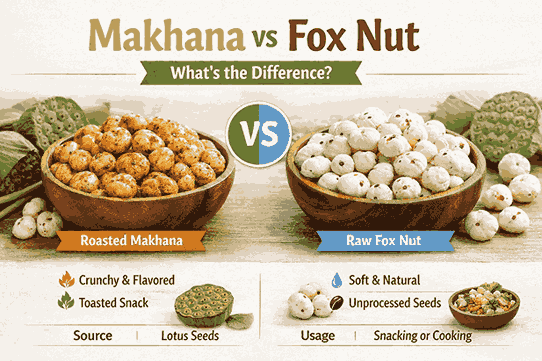
Introduction A funny thing happens the moment you start buying makhana regularly: you notice it’s having an identity crisis. One packet says “Makhana”, another says “Fox Nuts”, a third says “Lotus Seeds”—and suddenly you’re standing in the snack aisle wondering if you’ve been eating three different foods… or the same one in three different costumes. (I’ve been there. The first time I tried to “research” it, I ended up with five tabs open and more confusion than before.) So let’s settle it properly—with the botany, the food science, and the real-world “what does this label actually mean?” perspective—without turning it into a textbook. The quick answer In most everyday shopping and cooking contexts, fox nut and makhana refer to the same thing: the edible seed of the aquatic plant Euryale ferox—often sold in a puffed/popped form that looks like tiny white popcorn.  Where the confusion sneaks in is how people use the words: In other words: same botanical source, but the label sometimes hints at the form or processing.  The botanical backstory behind makhana If you only remember one scientific detail, make it this: makhana/fox nuts come from Euryale ferox—an aquatic plant in the water lily family (Nymphaeaceae).  A practical way to visualize it: Here’s the extra nuance that most quick blog posts miss: in formal Indian food terminology, “makhanna/makhana” is not just “a seed,” it’s a product form. A classic Indian standard (IS 3155:1965) describes “MAKHANNA” as the product obtained by roasting seeds from Euryale ferox and removing the outer black covering as much as possible.  That explains why some people (especially in food processing or trade circles) speak as if: Comparison that actually matters A lot of “difference” articles stop at “they’re the same.” True—but incomplete. The useful comparison is how the terms signal form, kitchen use, and what you’ll get if you order it in different markets. Term you’ll see What it usually refers to Botanical source Typical form you receive Most common culinary use makhana Often the processed, edible product Euryale ferox Usually popped/expanded white puffs Dry roasting & seasoning; also sweets like kheer  fox nuts Broad English common name; sometimes same as makhana Euryale ferox Either popped snack (like makhana) or dried kernels in some markets Snack form or cooked into soups/porridge depending on cuisine  gorgon nut Another common/trade name Euryale ferox Refers to the seed; may be sold dried before popping Ingredient use; can be processed into popped form  lotus seed A different food that gets confused with makhana Nelumbo nucifera Larger, smooth, often sold dried/shelled Desserts, seed paste, soups; can be eaten raw or dried  This table is based on botanical descriptions and processing definitions from university/peer-reviewed sources and food standards.  Key insights you rarely see on the label The “lotus seed” mix-up is real—and it changes what you’re buying Let’s be blunt: makhana is not lotus seed in the botanical sense, even though many packages and wellness articles casually blend the terms.  A tip I wish someone had told me earlier: if you’re buying for texture, this matters. Fast label-reading test:Look for the botanical name. Nutrition nuance: makhana is “light” in volume, not “low calorie” by default Makhana is often described online as a “light snack.” That’s emotionally true—and sometimes nutritionally misleading. What the data consistently shows is this: popped makhana is high in carbohydrates and low in fat, with moderate protein.  For example, one processing handbook reports popped makhana around 79.8% carbohydrate, 8.7% protein, and 0.5% fat, with a calorific value listed at 358 kcal per 100 g (values vary by moisture and processing). A broader technical review also summarizes raw seeds at about 76.9% carbohydrate, 9.7% protein, and 0.1% fat, again showing a similar “starchy seed, low fat” profile.  Here’s the real-life takeaway (the one that actually helps you snack smarter): Why makhana behaves differently from nuts in digestion and cooking Even when people call them “nuts,” fox nuts/makhana are starch-forward seeds, not oil-rich nuts like almonds or cashews—hence the popcorn-like puffing behavior.  That starch angle is also why researchers keep studying resistant starch and digestibility in Euryale ferox: If you’ve ever wondered why makhana can feel more like “a crunchy carb snack” than “a handful of nuts,” that’s why. Sourcing matters because it’s an aquatic crop This is the perspective that shifted the way I buy makhana: it’s not just a snack; it’s an aquatic crop, and aquatic plants can reflect their growing environment.  A well-cited study found that toxic metal contents in Euryale ferox seeds were positively correlated with metal concentrations in the surrounding water and sediments (in the study’s context), raising a clear “water quality matters” point.  That doesn’t mean “avoid makhana.” It means buy from suppliers who care about sourcing and testing, especially if you consume it frequently. Makhana isn’t just a “new superfood”—it has serious economic and regulatory weight Makhana’s popularity isn’t only Instagram-driven; it’s backed by production systems, standards, and even international approvals. How I buy and cook makhana at home This is the part you came for if you’re a practical reader (hello, fellow snack optimizer). Buying checklist I actually use I keep it simple: My go-to roasting method I used to burn makhana because I treated it like popcorn. The trick is gentler. What works for me: Roasting/processing is central to what makhana is as a product (that’s literally how older standards define it).  How I use it beyond “movie snack” If your only mental model is “spiced makhana in a bowl,” try these: Frequently Asked Questions (FAQs) 1. Is makhana the same as fox nut? Yes, makhana and fox nuts refer to the same food. “Makhana” is the commonly used name in India, while “fox nuts” is the English term used globally for the seeds of the lotus plant. 2. Why are they called fox nuts? The name “fox nut” comes from the plant species Euryale ferox. The word “ferox” means fierce or strong, which eventually led to the term “fox nut” in English. 3. Is there any difference in taste between makhana and fox nuts? No, there is no difference in taste. Both names describe the same popped seed, which has a mild, slightly nutty flavor that easily absorbs seasonings. 4. Are makhana and fox nuts grown in different regions? Not really. Most makhana (fox nuts) are cultivated in

Golmoti – Premium Quality Makhana

Our Promise

At Golmoti, premium quality makhana comes first.
We ensure every pack delivers freshness, purity, and authentic taste.

Contact Us

India,Bihar, Dist-Darbhanga,Benipur,Pauri.847201

support@golmoti.com

Copyright ©  2026 All right reserved

Scroll to Top