
The Crunch Heard ‘Round the World
Picture this: It’s Friday night. The lights are dim, the screen is glowing, and your hand instinctively dives into a bowl of something salty and crunchy. For decades, that bowl has been dominated by one king—popcorn. But lately, a quiet, ancient contender has been slipping into the pantries of nutritionists and wellness enthusiasts alike: Fox Nuts.

Also known as Makhana or Gorgon nuts, these puffy white seeds don’t look like much at first glance. They resemble tiny, crispy clouds. But when placed head-to-head against the cinematic staple we all know and love, the results are surprisingly dramatic.
If you are looking for a snack that satisfies the craving for crunch without the nutritional baggage, it’s time to dive into the ultimate showdown: Fox Nuts vs. Popcorn.
Round 1: Fox Nuts: The Nutritional Knockout
To understand which snack deserves a permanent spot in your cupboard, we have to look past the taste and examine what we are actually putting into our bodies.
The Case for Popcorn
Popcorn isn’t inherently bad. In its pure, air-popped form, it’s a whole grain. It contains fiber and is relatively low in calories. According to the USDA, three cups of air-popped popcorn contain about 93 calories and 3.6 grams of fiber.
But the real issue isn’t popcorn itself—it’s the way most people eat it. Most people don’t eat air-popped popcorn. They eat microwave bags lined with perfluoroalkyl substances (PFAS) or theater versions drenched in butter-like topping (coconut oil and artificial flavoring). A medium-sized movie theater popcorn can pack over 1,000 calories and a day’s worth of saturated fat.
The Makhana Advantage
Fox Nuts are not a grain; they are a seed harvested from the Euryale ferox plant, a water lily found in stagnant water bodies across Asia. This botanical difference matters.
Unlike corn, which is a starchy carbohydrate, fox nuts are composed of complex carbohydrates, protein, and a surprisingly high mineral density.
- Protein Power: Fox nuts contain about 9-12 grams of protein per 100 grams, compared to popcorn’s 3-4 grams.
- Micronutrient Density: They are rich in calcium (helping with bone health), magnesium (for muscle recovery), and manganese.
- The AGE Advantage: One of the most unique benefits of fox nuts is their high flavonoid content. Studies suggest these antioxidants help reduce inflammation and manage blood sugar spikes—something popcorn, with its higher glycemic index, struggles to compete with.
Round 2: Fox Nuts: The Culinary Experience & Versatility
If nutrition were the only factor, we would all be eating steamed kale. Texture and flavor matter. This is where things get intriguing.

The Popcorn Experience
Popcorn offers a specific sensory experience: the shatter. It’s light, airy, and has an immense surface area for flavor. However, popcorn has a notorious Achilles’ heel—it gets stuck in your teeth. Moreover, it cools down quickly and becomes chewy or soggy if left out. Flavor-wise, while it can handle savory or sweet, it often requires a lot of oil to get the seasoning to stick.
The Fox Nuts Experience
Roasted Fox Nuts offer a different kind of crunch—one that is often described as a cross between a crouton and a popcorn kernel, but without the hulls to get stuck in your gums. When dry-roasted in ghee or avocado oil, they puff up into a crisp, melt-in-the-mouth texture that holds seasoning far better than popcorn.
Here is where the versatility shines. Because they have a neutral flavor base (unlike popcorn’s distinct corn taste), fox nuts are a culinary chameleon:
- Savory: Toss them in turmeric, black salt, and a touch of chili powder for a spicy trail mix.
- Sweet: Roast them with a drizzle of maple syrup and cinnamon for a dessert bowl that tastes like apple pie filling without the guilt.
- Gourmet: You can even grind them into a flour to thicken soups or make gluten-free crackers.
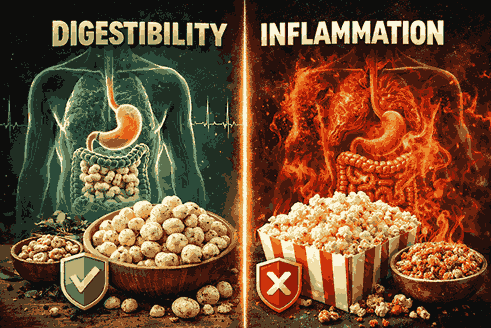
Round 3: Fox Nuts: Digestibility and Inflammation
Snacking habits often fail because of how the food makes us feel after eating it. This is a critical area where the two diverge.
The Dark Side of Corn
Corn is a common allergen. For many people, it can be difficult to digest due to the cellulose in the hull. Even organic popcorn can cause bloating or discomfort for those with sensitive guts. Furthermore, the aflatoxin risk—a type of mold that can grow on corn crops—is a concern for conventional popcorn farming.
Why Fox Nuts Are Easier on the Gut
In Ayurveda (the ancient Indian system of medicine), Makhana (Fox Nuts) is considered one of the few snacks that is “Sattvic”—pure and balancing. It is often prescribed to people recovering from illness or those with digestive issues because it is:
- Astringent: It helps dry excess moisture in the digestive tract (helpful for diarrhea).
- Non-Acidic: Unlike processed snacks, it doesn’t trigger acid reflux.
For anyone dealing with GERD or bloating, switching to Fox Nuts can be a game-changer. They provide the satisfaction of snacking without the post-meal regret.
Round 4: Fox Nuts: Environmental Impact

As conscious consumers, we have to consider not just what goes into our bodies, but what the impact on the planet is.
The Environmental Cost of Corn
Commercial corn production is resource-intensive. According to the Environmental Working Group (EWG) , conventional corn is one of the most pesticide-heavy crops in the world. It requires massive amounts of water, synthetic fertilizers, and heavy machinery.
The Sustainability of Fox Nuts
Here is a “fresh perspective” that rarely gets discussed: Fox Nuts are an environmental hero. They are cultivated in stagnant ponds and wetlands in regions like Bihar, India. The cultivation process:
- Uses minimal resources: The water lilies grow naturally in shallow water without the need for irrigation.
- Supports biodiversity: The wetlands provide habitats for local wildlife.
- Empowers local economies: The harvesting is done manually by small-scale farmers, often women, preserving traditional agricultural practices rather than industrial monocropping.
When you choose fox nuts, you often support regenerative agriculture practices that sustain wetlands rather than drain them.
The Verdict: A Side-by-Side Comparison (Fox Nuts)
To make the decision easier, here is a breakdown of how they stack up:
| Feature | Popcorn (Air-popped) | Fox Nuts (Roasted) |
|---|---|---|
| Texture | Light, shattery; hulls get stuck in teeth | Crispy, crunchy; dissolves smoothly |
| Calories | ~31 cal/cup | ~35-40 cal/cup (similar density) |
| Protein | Low (~1g per cup) | Moderate (~3g per cup) |
| Digestion | Can cause bloating; high fiber | Astringent; easy on digestion; anti-inflammatory |
| Flavor Profile | Dominant corn taste; requires butter | Neutral; absorbs spices without heavy fats |
| Sustainability | High water/pesticide use | Wetland-friendly; low carbon footprint |
| Blood Sugar | High Glycemic Index (spike) | Low Glycemic Index (steady energy) |
Fox Nuts: How to Make the Switch (Without Missing the Movies)
I’ll be honest: for the first week, I missed the smell of buttered popcorn. But once I mastered the art of roasting Fox Nuts, I never looked back.
Here is my personal recipe for “Movie Night Makhana” that replicates the cinema vibe without the grease:
- Heat the Fat: Use 1 tablespoon of grass-fed ghee or coconut oil in a pan. Ghee gives it that buttery aroma without the inflammatory vegetable oils found in popcorn bags.
- Roast, Don’t Burn: Add the fox nuts and roast on medium heat for 3-4 minutes. You’ll hear them “pop” slightly as they puff up. Keep moving them so they don’t burn.
- Season Like a Pro: Once they are golden and crisp, turn off the heat. Sprinkle nutritional yeast (for a cheesy flavor), garlic powder, and smoked paprika.
- The Secret Ingredient: Add a tiny pinch of black salt (Kala Namak) . This mimics the sulfurous, savory “egginess” that often makes movie theater popcorn so addictive.
Conclusion: The Future of Snacking
Snacking shouldn’t be a guilty pleasure; it should be fuel that tastes good and feels good. While popcorn will always hold a nostalgic place in our hearts (and our Netflix queues), Fox Nuts offer a superior alternative for the health-conscious, environmentally aware consumer.
They win on digestibility, they win on nutrient density, and they win on versatility. Whether you are managing blood sugar levels, looking to reduce inflammation, or simply tired of finding popcorn kernels in your teeth, it’s time to give this ancient superfood a modern spotlight.
The next time you settle in for a movie, look beyond the yellow bag. Try the crispy, cloud-like crunch of fox nuts. Your gut—and the planet—will thank you.
Disclaimer: The information provided in this article is for educational and informational purposes only and should not be considered medical advice. Always consult a qualified healthcare provider before making any major changes to your diet or lifestyle.
[…] exactly why Fox Nuts (aka makhana) have become my favorite “blank canvas” ingredient. They’re light, crunchy, […]
[…] Fox Nuts are healthy, edible seeds that come from the Euryale ferox plant, also known as lotus seeds, popular in fitness diets. When roasted, they puff up like mini popcorns. They may look like plain white puffs, but nutritionally they pack a punch for their size. One cup (about 32g) of roasted makhana contains roughly 106 calories, 5 g protein, and a burst of minerals like calcium, magnesium, and potassium. This makes them relatively high in protein and micronutrients for a snack, especially compared to typical chips or popcorn. […]