
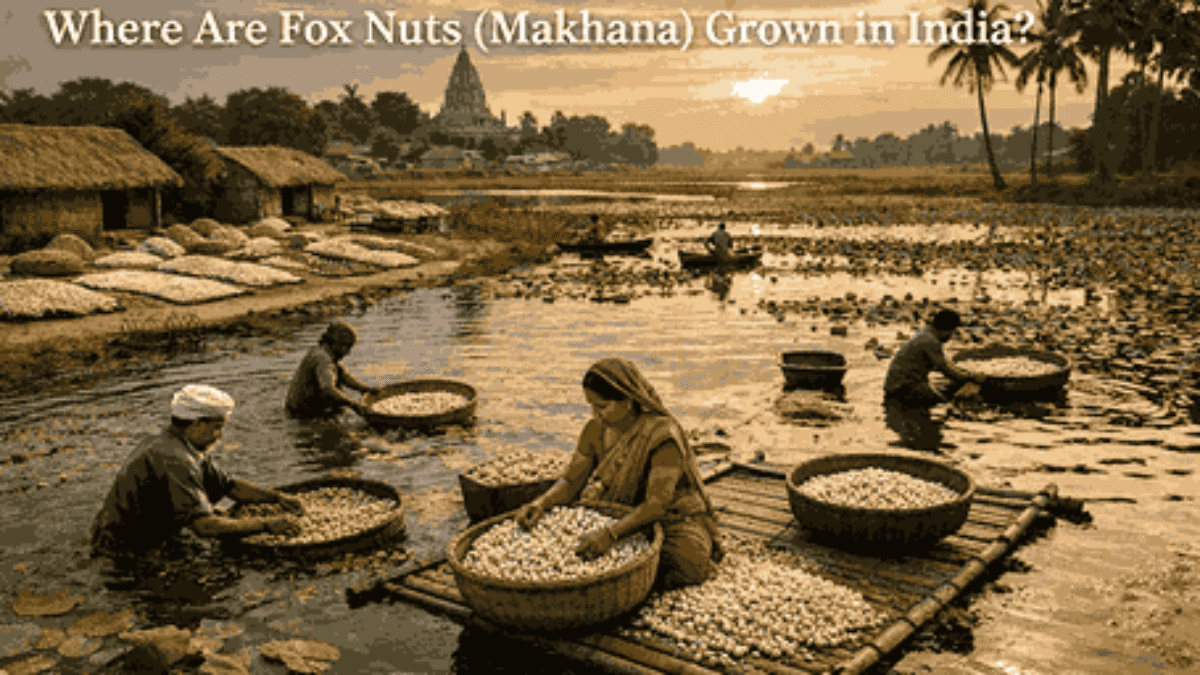
Introduction: The Hidden Journey of Makhana
If you’ve ever enjoyed a bowl of crunchy makhana, you might have wondered—where does this unique snack actually come from?
Unlike almonds or peanuts, fox nuts doesn’t grow on trees or underground. It comes from water. Yes, the humble fox nut (makhana) is an aquatic crop, deeply rooted in India’s traditional farming systems.
India is not just a producer—it’s the global leader in fox nuts cultivation, contributing nearly 80–90% of the world’s supply. And at the heart of this industry lies one state: Bihar.
But the story doesn’t end there. Let’s explore where fox nuts is grown in India, why certain regions dominate, and how this ancient crop is shaping livelihoods today.
Where Is Makhana Grown in India? (Core Regions Explained)
1. Bihar – The Primary Source of Makhana in India

When we talk about fox nuts, Bihar is the undisputed king.
- Produces ~80% of India’s makhana
- Major districts:
- Darbhanga
- Madhubani
- Sitamarhi
- Supaul
- Purnia
- Katihar
- Araria
These regions fall under the Mithila belt, where natural wetlands and ponds create the perfect ecosystem for fox nuts cultivation.
Why Bihar dominates:
- Abundant lowland ponds and wetlands
- Ideal climate (warm + humid)
- Traditional knowledge passed through generations
- Skilled labor for manual harvesting & roasting
Fun insight: fox nuts farming here is not just agriculture—it’s a cultural identity. Many families have been cultivating it for decades.
2. West Bengal – The Emerging Player
West Bengal is slowly becoming a strong contributor to fox nuts production.
- Key areas:
- Malda
- Cooch Behar
- North Dinajpur
Why it works:
- Similar wetland geography as Bihar
- Increasing government support for diversification
- Farmers shifting from rice to high-value crops like makhana
3. Assam & Northeast India – Untapped Potential
The Northeast has huge potential but remains underutilized.
- States:
- Assam
- Manipur (small-scale)
Advantages:
- Plenty of natural water bodies
- Favorable rainfall patterns
Challenges:
- Lack of processing infrastructure
- Limited awareness and training
4. Eastern Uttar Pradesh – Small but Growing
Some districts in eastern UP are experimenting with makhana farming:
- Gorakhpur
- Deoria
This region shares similar climatic conditions with Bihar, making it suitable for expansion.
Comparison: Makhana Growing Regions in India
| Region | Production Share | Key Strength | Growth Potential |
|---|---|---|---|
| Bihar | ⭐⭐⭐⭐⭐ (~80%) | Expertise + natural wetlands | High |
| West Bengal | ⭐⭐⭐ | Similar geography + support | High |
| Assam/Northeast | ⭐⭐ | Untapped water resources | Very High |
| Uttar Pradesh | ⭐⭐ | Expanding cultivation | Moderate |
Why Makhana Grows Only in Specific Regions?
Not every place can grow fox nuts. It requires very specific conditions:
Climate Requirements
- Temperature: 20°C – 35°C
- High humidity
- Seasonal rainfall
Water Conditions
- Shallow ponds or wetlands
- Still water (not flowing rivers)
Soil Type
- Clay-rich, nutrient-dense soil
This is why regions like Rajasthan or Punjab are not suitable for fox nuts cultivation.
The Farming Process: Why It’s So Unique
Makhana farming is unlike any other crop.
Step-by-step:
- Seeds are sown in ponds
- Plants spread across the water surface
- Seeds are collected manually from underwater
- Seeds are dried and roasted
- Finally, they are popped into fox nuts
This labor-intensive process is why makhana is often considered a premium snack.
Economic & Livelihood Impact
Makhana is not just a crop—it’s a rural economy driver.
- Supports lakhs of farmers in Bihar
- Provides employment in:
- Harvesting
- Processing
- Packaging
According to data from organizations like the Indian Council of Agricultural Research, fox nuts cultivation is being promoted as a high-value crop for income growth.
GI Tag & Bihar’s Global Identity
Did you know?
Bihar’s makhana has received a Geographical Indication (GI) tag, which means:
- Authentic fox nuts comes from specific regions
- It has unique quality and taste
- It boosts export potential
This makes “Bihar Makhana” a premium global product.
Key Insights You Should Know
✔ India dominates global fox nuts production
✔ Bihar alone contributes ~80%
✔ Makhana grows in water, not soil fields
✔ Farming is labor-intensive but highly profitable
✔ Northeast India could be the next big hub
Conclusion: From Ponds to Premium Snack
The journey of makhana is truly fascinating. From the still ponds of Bihar to modern snack shelves, it represents a perfect blend of tradition and nutrition.
As demand for healthy snacks rises, fox nuts is not just surviving—it’s thriving.
And for brands like Golmoti, this is a golden opportunity. Understanding where makhana is grown helps you build a strong brand story, something that connects emotionally with your audience.
Call-to-Action (CTA)
Loved learning about makhana’s origin?
Share this article with someone who loves healthy snacks
Explore more insights on Golmoti
Or better—try premium makhana and experience the crunch yourself