
Introduction
If you’ve ever grabbed a handful of makhana and thought, “This is popcorn—but… softer, cleaner, oddly elegant,” you’re not imagining it. Makhana (fox nuts) does “pop,” but its origin story is completely different: it comes from an aquatic plant, not a grass like corn.
That small detail changes how you should think about fox nuts—its flavor, its texture, its nutrition, and even the livelihoods behind it. In India, the crop has long been rooted in the wetlands of Bihar, and recent policy and market attention has accelerated its move from a regional staple to a national and global snack.
What follows is a deeper, more grounded answer to a simple question: what is makhana—really?
What is makhana?
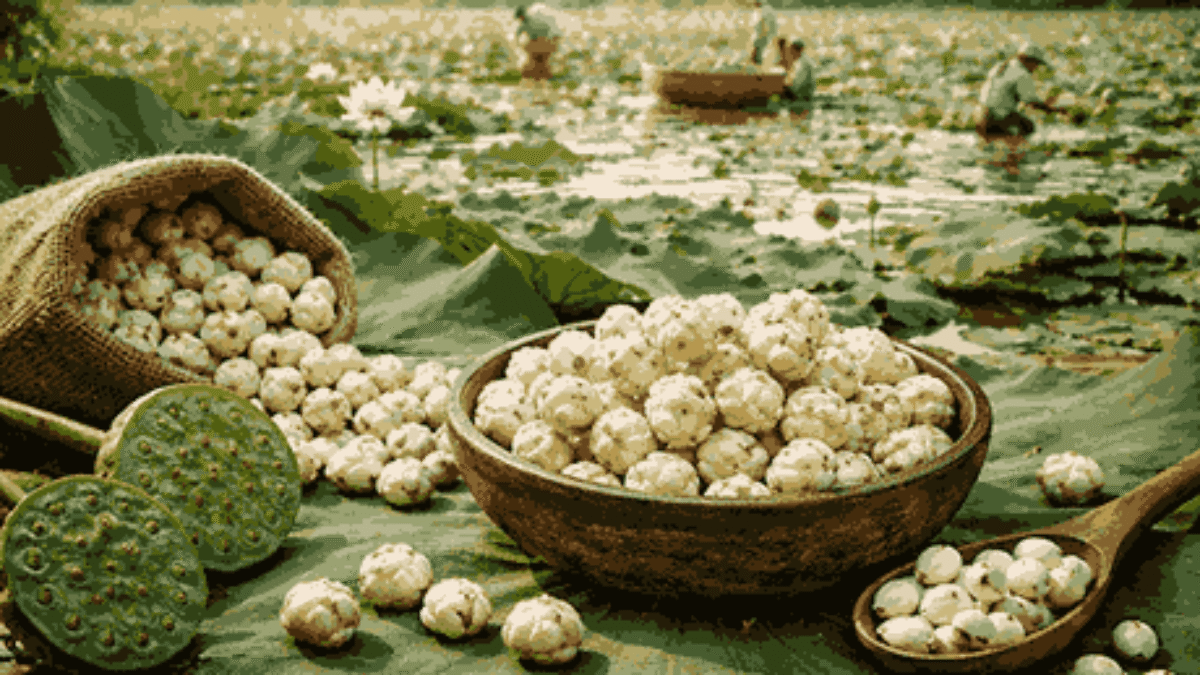
At its core, makhana (fox nuts) is the popped, expanded kernel/seed of the gorgon nut—a water plant scientifically known as Euryale ferox. The plant lives in still or slow-moving freshwater (think ponds and wetlands), and the edible seed is transformed through heat into the white, lightweight “puffs” we recognize as makhana (fox nuts).
Botanically, Euryale ferox is part of the water-lily order and the family Nymphaeaceae, and its accepted native range stretches from northern India to Taiwan, according to the Kew-backed reference database.
In India, the crop is strongly associated with Bihar—especially the Mithila region—where it has traditionally supported a large wetland-based cultivation and processing ecosystem.
How makhana becomes “puffed”
Makhana is famous for being simple to eat, but surprisingly complex to make well. Research on gorgon nut processing describes the traditional sequence as a multi-step workflow that can include drying → roasting → tempering (resting) → a second roasting → popping, with the best-grade recovery coming from that full sequence rather than a single heat step.
That “puff” you experience is not random—it’s engineered by moisture, heat, timing, and technique. That’s also why the same brand of makhana (fox nuts) can taste cardboard-dry one month and beautifully crisp the next: small changes in processing and storage can show up dramatically in texture.
One common confusion to clear up
You’ll sometimes see makhana casually described as “lotus seeds” in food conversations, especially outside India. But makhana (fox nuts) is specifically tied to Euryale ferox (gorgon nut). If you’re shopping internationally, this matters because “lotus seed” products can refer to other plants and have different cooking behavior (often chewier, less airy, and not naturally “popped” in the same way).
Makhana compared with popcorn and nuts
A good comparison does two things: it respects what makhana (fox nuts) is, and it avoids forcing it into the wrong category.
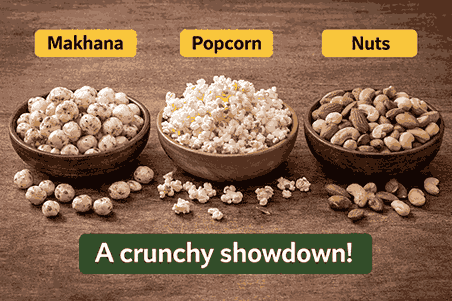
Makhana is a “puffed snack” like popcorn—but nutritionally it behaves more like a very low-fat, starch-forward seed. It also gets marketed like a “dry fruit” (nuts category), even though its fat profile is dramatically different from almonds or cashews. A recent APEDA report (focused on India’s makhana (fox nuts)value chain and exports) publishes a clean, side-by-side snapshot that’s useful for reality-checking the hype.
| Nutrient (per 100 g) | Almond | Cashew | Popcorn | Popped makhana |
|---|---|---|---|---|
| Protein (g) | 18.41 | 18.78 | 12.9 | 11.03 |
| Fat (g) | 58.49 | 45.2 | 4.54 | 0.33 |
| Carbohydrates (g) | 3.04 | 25.46 | 77.8 | 84.87 |
| Fiber (g) | 13.06 | 3.86 | 14.5 | 3.26 |
| Sodium (mg) | 1.5 | 9.0 | 8.0 | 4.06 |
What this table quietly implies is the most important insight for everyday eating:
Makhana isn’t here to replace nuts — it’s here to replace your crunch cravings.“
If you snack on nuts for fats (satiety) and minerals, makhana won’t mimic that. But if you snack for volume + crunch and you want to keep added fat low, makhana (fox nuts) has a real advantage.
Key insights that most “superfood” posts miss
A lot of content online treats makhana like a magic food. The better story is more practical: mukhana is a smart base ingredient—if you understand what it is and what you’re adding to it.
The glycemic index story is real, but nuanced
One of the most cited benefits of makhana (fox nuts) is its relationship to blood sugar. Here’s what the better evidence says:
An open-access, peer-reviewed study measured the glycemic index of roasted fox nuts in human subjects (n=10) and reported a GI around 37, which falls into the commonly recognized “low GI” category (≤55).
But nuance matters:
- Small sample size means you should treat the number as informative—not absolute truth for every body.
- GI isn’t a magic shield. Portion size, what you eat with it (fat/protein), and your own metabolism still drive the real-world glucose response.
A helpful mental model: makhana is “carb-forward,” but not necessarily “spike-forward,” especially when eaten plain and roasted versus sugar-coated or deep-fried.
The “healthy snack” can flip when you add oils, sugar, or heavy seasoning
This is where makhana’s reputation rises or falls.
Plain popped makhana (fox nuts) is extremely low in fat. That’s why it feels so “light,” and why it’s easy to snack mindlessly. But it also means many people instinctively make it taste better by adding:
- ghee or oil (for aroma and mouthfeel)
- sugar/jaggery (for “chikki vibes”)
- extra salt and intense masalas (for “chips vibes”)
None of those choices are “bad”—but they re-write the nutrition story.
A useful benchmark: World Health Organization recommends adults keep sodium under 2000 mg/day (about 5 g/day of salt). If your makhana is coming from heavily salted, flavored packets (or you’re free-pouring seasoning), it’s worth reading labels—because the base is low sodium, but the product might not be.
The supply chain angle: makhana is also a livelihood crop
The most overlooked “unique insight” about makhana isn’t nutritional—it’s economic.
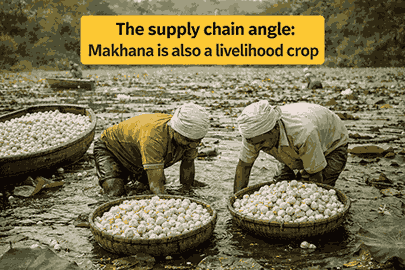
A major 2025 report on India’s makhana exports notes that India accounts for about 90% of global makhana production, with Bihar contributing 85–90% of India’s production, yet only a small portion (around 1–2%) is exported.
That gap explains why you’re seeing rapid innovation: shelf-stable formats, better grading, and products designed for export consistency.
It also explains why makhana pricing can swing: when a crop is concentrated in one geography and processing is specialized, supply shocks (weather, labor availability, storage) can ripple fast.
On the policy side, the same export report flags that India’s Union Budget 2025 announcements included the establishment of a dedicated makhana board (with an initial allocation mentioned), signaling institutional support for formalizing the sector.
Finally, to connect culture and commerce: the report also notes Geographical Indication (GI) recognition for “Mithila Makhana” in 2022, which boosted visibility and credibility.
Conclusion and call to action
So, what is makhana?
It’s the popped seed of an aquatic water-lily relative (Euryale ferox), shaped by a precise processing tradition (drying, roasting, resting, and popping) into a snack that’s uniquely low in fat, high in carbohydrates, and surprisingly versatile in both savory and sweet foods.
The best way to enjoy it is also the simplest: treat makhana as a blank canvas, then season with intention—because the “healthiness” isn’t only in the seed, it’s in what you do next.
Your turn: How do you eat makhana—plain roasted, masala, kheer, or something more creative? Share your go-to mix (and your region’s style). If you want more deep dives like this, subscribe or bookmark our upcoming reads on label-reading for snacks, low-GI snack ideas, and high-protein Indian pantry staples.