Introduction
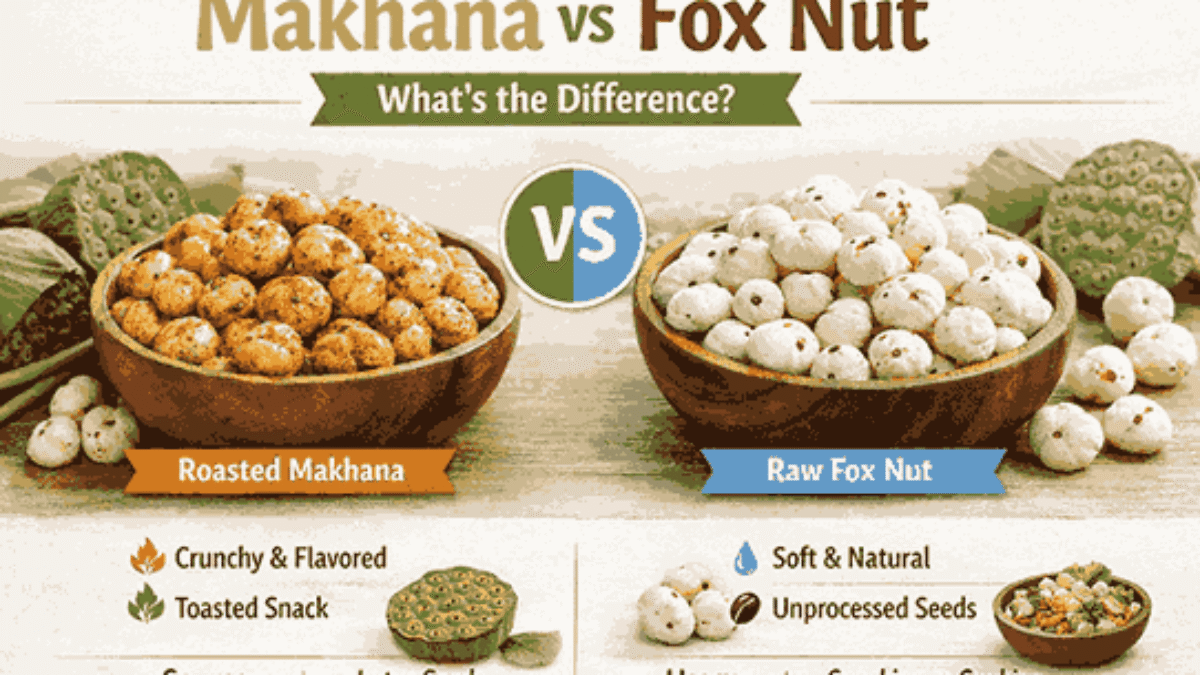
A funny thing happens the moment you start buying makhana regularly: you notice it’s having an identity crisis.
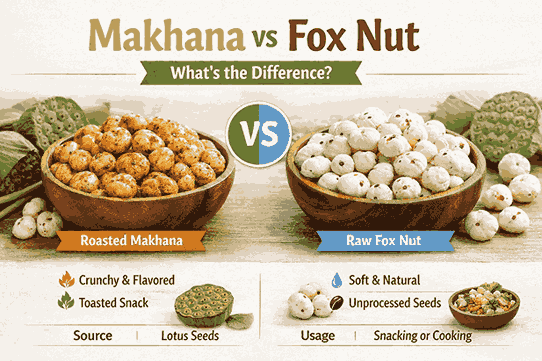
One packet says “Makhana”, another says “Fox Nuts”, a third says “Lotus Seeds”—and suddenly you’re standing in the snack aisle wondering if you’ve been eating three different foods… or the same one in three different costumes. (I’ve been there. The first time I tried to “research” it, I ended up with five tabs open and more confusion than before.)
So let’s settle it properly—with the botany, the food science, and the real-world “what does this label actually mean?” perspective—without turning it into a textbook.
The quick answer
In most everyday shopping and cooking contexts, fox nut and makhana refer to the same thing: the edible seed of the aquatic plant Euryale ferox—often sold in a puffed/popped form that looks like tiny white popcorn.
Where the confusion sneaks in is how people use the words:
- “Fox nuts” is commonly used as an English common name for the seeds.
- “Makhana” is widely used in South Asia (especially in India) and, in trade/food standards, it often implies the processed form—roasted/popped seeds with the outer covering removed.
In other words: same botanical source, but the label sometimes hints at the form or processing.
The botanical backstory behind makhana
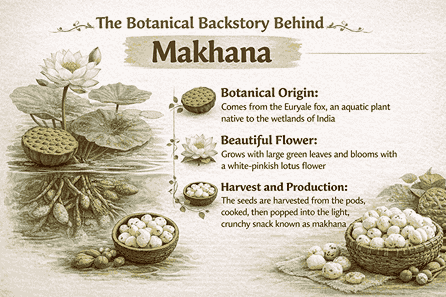
If you only remember one scientific detail, make it this: makhana/fox nuts come from Euryale ferox—an aquatic plant in the water lily family (Nymphaeaceae).
A practical way to visualize it:
- The plant grows in freshwater bodies (ponds, shallow water systems).
- The seeds are harvested and then roasted—and that roasting is what makes them puff “like popcorn,” which is why fox nuts feels like a snack rather than a “seed” in your head.
Here’s the extra nuance that most quick blog posts miss: in formal Indian food terminology, “makhanna/makhana” is not just “a seed,” it’s a product form.
A classic Indian standard (IS 3155:1965) describes “MAKHANNA” as the product obtained by roasting seeds from Euryale ferox and removing the outer black covering as much as possible.
That explains why some people (especially in food processing or trade circles) speak as if:
- “fox nut” = the seed (raw identity)
- “makhana” = the roasted/popped edible product (snack identity)
Comparison that actually matters
A lot of “difference” articles stop at “they’re the same.” True—but incomplete. The useful comparison is how the terms signal form, kitchen use, and what you’ll get if you order it in different markets.
| Term you’ll see | What it usually refers to | Botanical source | Typical form you receive | Most common culinary use |
|---|---|---|---|---|
| makhana | Often the processed, edible product | Euryale ferox | Usually popped/expanded white puffs | Dry roasting & seasoning; also sweets like kheer |
| fox nuts | Broad English common name; sometimes same as makhana | Euryale ferox | Either popped snack (like makhana) or dried kernels in some markets | Snack form or cooked into soups/porridge depending on cuisine |
| gorgon nut | Another common/trade name | Euryale ferox | Refers to the seed; may be sold dried before popping | Ingredient use; can be processed into popped form |
| lotus seed | A different food that gets confused with makhana | Nelumbo nucifera | Larger, smooth, often sold dried/shelled | Desserts, seed paste, soups; can be eaten raw or dried |
This table is based on botanical descriptions and processing definitions from university/peer-reviewed sources and food standards.
Key insights you rarely see on the label
The “lotus seed” mix-up is real—and it changes what you’re buying
Let’s be blunt: makhana is not lotus seed in the botanical sense, even though many packages and wellness articles casually blend the terms.
- Lotus seeds come from Nelumbo nucifera (true lotus).
- Makhana/fox nuts come from Euryale ferox (prickly water lily/gorgon plant).
A tip I wish someone had told me earlier: if you’re buying for texture, this matters.
- The snack most people love as “makhana” is loved because it’s light and puffed—that comes from the way Euryale ferox seeds are processed to pop.
- Lotus seeds, meanwhile, are commonly used in desserts and fillings (and yes, they can be eaten in different forms), but they’re not automatically the same “popcorn-like” snack you’re expecting when you buy makhana.
Fast label-reading test:
Look for the botanical name.
- If it says Euryale ferox → you’re in makhana/fox nut territory.
- If it says Nelumbo nucifera → lotus seed.
Nutrition nuance: makhana is “light” in volume, not “low calorie” by default
Makhana is often described online as a “light snack.” That’s emotionally true—and sometimes nutritionally misleading.
What the data consistently shows is this: popped makhana is high in carbohydrates and low in fat, with moderate protein.
For example, one processing handbook reports popped makhana around 79.8% carbohydrate, 8.7% protein, and 0.5% fat, with a calorific value listed at 358 kcal per 100 g (values vary by moisture and processing).
A broader technical review also summarizes raw seeds at about 76.9% carbohydrate, 9.7% protein, and 0.1% fat, again showing a similar “starchy seed, low fat” profile.
Here’s the real-life takeaway (the one that actually helps you snack smarter):
- A big bowl looks like a lot, because makhana is airy.
- But calories depend on what you add: roasting in ghee/oil and seasoning can change the snack from “light, crunchy” to “calorie-dense” quickly.
Why makhana behaves differently from nuts in digestion and cooking
Even when people call them “nuts,” fox nuts/makhana are starch-forward seeds, not oil-rich nuts like almonds or cashews—hence the popcorn-like puffing behavior.
That starch angle is also why researchers keep studying resistant starch and digestibility in Euryale ferox:
- A PubMed-indexed study looked at increasing resistant starch content in popped makhana to address rapid starch digestibility and glycemic response concerns.
- Food science work has also used Euryale ferox starch to prepare type-3 resistant starch (RS3), a form associated with slower digestion in general starch science.
If you’ve ever wondered why makhana can feel more like “a crunchy carb snack” than “a handful of nuts,” that’s why.
Sourcing matters because it’s an aquatic crop
This is the perspective that shifted the way I buy makhana: it’s not just a snack; it’s an aquatic crop, and aquatic plants can reflect their growing environment.
A well-cited study found that toxic metal contents in Euryale ferox seeds were positively correlated with metal concentrations in the surrounding water and sediments (in the study’s context), raising a clear “water quality matters” point.
That doesn’t mean “avoid makhana.” It means buy from suppliers who care about sourcing and testing, especially if you consume it frequently.
Makhana isn’t just a “new superfood”—it has serious economic and regulatory weight
Makhana’s popularity isn’t only Instagram-driven; it’s backed by production systems, standards, and even international approvals.
- A processing handbook describes harvesting as manual collection (including diving in water bodies) and provides production estimates, noting that Bihar is the leading state and is estimated to account for more than 80% of India’s makhana production.
- A statement in Press Information Bureau notes that Darbhanga (and the Mithila area more broadly) is a major producing region, in the context of the National Research Centre for Makhana and its mandate.
- In 2022, news reporting on GI registration noted that “Mithila Makhana” was registered with a GI tag.
- The European Commission authorised roasted and popped kernels from Euryale ferox (makhana) as a “traditional food from a third country,” and even specifies acceptable naming on labels (e.g., “roasted seeds of Euryale ferox” or “makhana (Euryale ferox) roasted seeds”).
- A 2025 release from Press Information Bureau also highlights export momentum, describing a GI-tagged Mithila Makhana consignment being flagged off and referencing support through Agricultural and Processed Food Products Export Development Authority.
How I buy and cook makhana at home
This is the part you came for if you’re a practical reader (hello, fellow snack optimizer).
Buying checklist I actually use
I keep it simple:
- Check the botanical name when possible. I prefer Euryale ferox clearly stated so there’s no lotus-seed confusion.
- Choose a reasonable grade for your use-case. Larger, fully expanded puffs tend to feel more premium for snacking, while smaller/irregular pieces can be perfect for kheer, curries, or grinding into flour.
- Buy from brands/sellers you trust, because cultivation and harvesting are tied to water systems.
My go-to roasting method
I used to burn makhana because I treated it like popcorn. The trick is gentler.
What works for me:
- Heat a pan on low-medium.
- Add a small amount of fat (or dry roast).
- Stir constantly for several minutes until it turns crisp (you’ll hear a subtle change in sound).
- Season at the end.
Roasting/processing is central to what makhana is as a product (that’s literally how older standards define it).
How I use it beyond “movie snack”
If your only mental model is “spiced makhana in a bowl,” try these:
- Kheer: Many sources note its use in porridge/pudding-style preparations, especially in India.
- Curries and gravies: It’s used in traditional dishes (often as a texture element).
- Soup/porridge in Chinese cuisine traditions: Separate from the popped snack form, dried kernels are used in soups and are discussed in ethnobotanical and review literature.
Frequently Asked Questions (FAQs)
1. Is makhana the same as fox nut?
Yes, makhana and fox nuts refer to the same food. “Makhana” is the commonly used name in India, while “fox nuts” is the English term used globally for the seeds of the lotus plant.
2. Why are they called fox nuts?
The name “fox nut” comes from the plant species Euryale ferox. The word “ferox” means fierce or strong, which eventually led to the term “fox nut” in English.
3. Is there any difference in taste between makhana and fox nuts?
No, there is no difference in taste. Both names describe the same popped seed, which has a mild, slightly nutty flavor that easily absorbs seasonings.
4. Are makhana and fox nuts grown in different regions?
Not really. Most makhana (fox nuts) are cultivated in India, especially in Bihar. The difference lies only in naming, not in origin or production.
5. Which term is better for SEO: makhana or fox nuts?
Both keywords are useful. “Fox nuts” has higher global search volume, while “makhana” is more popular in India. Using both together in your content can improve reach.
Conclusion and CTA
So—what’s the difference between fox nut and makhana?
Most of the time, none in the botanical sense: both point back to Euryale ferox.
The real “difference” is a language-and-processing story: “fox nut” is the common English name for the seed, while “makhana” often signals the roasted/popped product form people snack on.
And the smartest thing you can do as a buyer is stop relying on nicknames and start relying on the botanical name—especially to avoid the lotus-seed mix-up.
Your turn: Have you seen makhana labeled as “lotus seeds” where you live—or do you use “fox nuts” and “makhana” differently in your kitchen? Share your experience (and your favorite seasoning combo), and if you found this helpful, pass it on to the one friend who still thinks makhana is an actual nut.